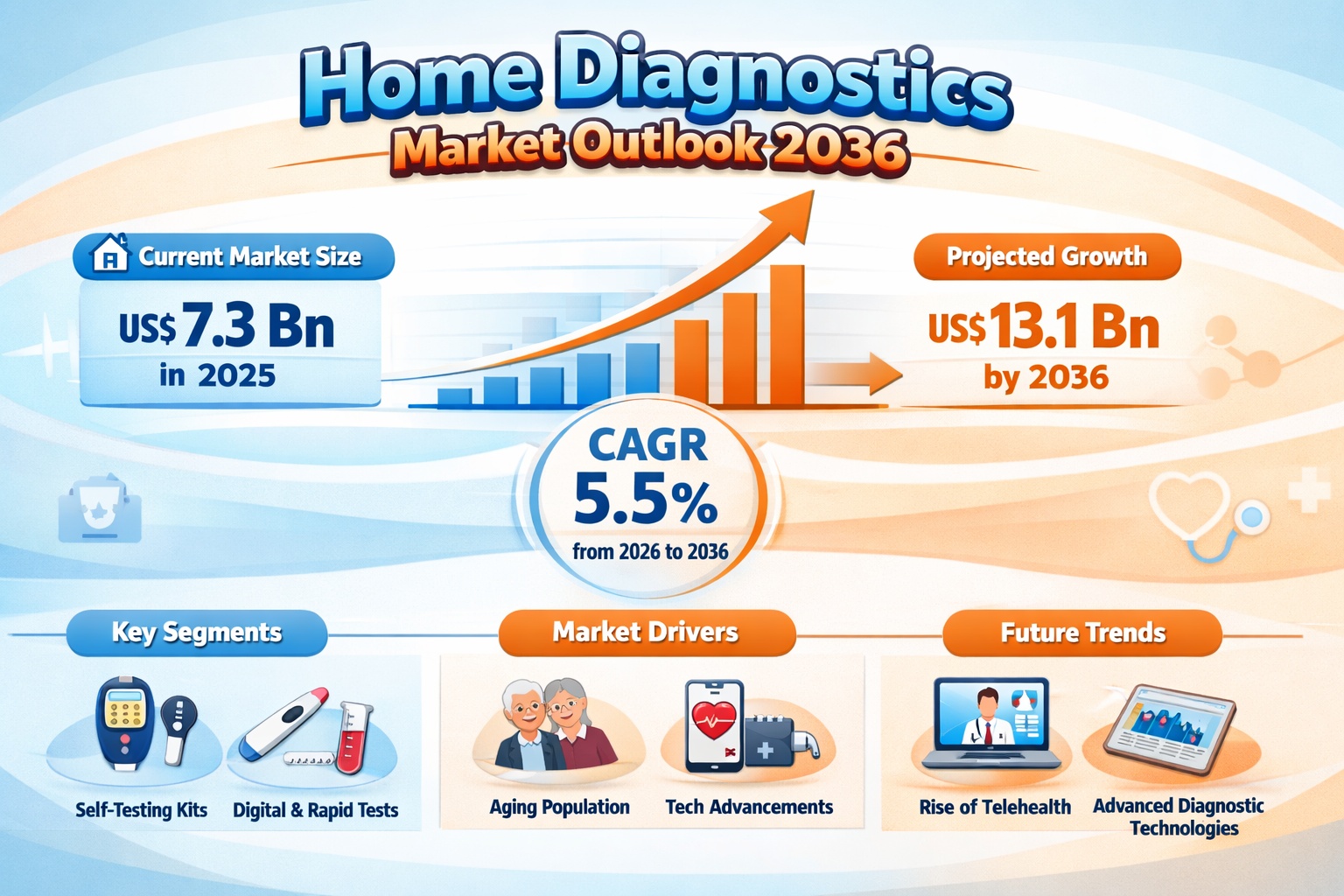
The global home diagnostics market is poised for steady expansion over the next decade, driven by rising demand for decentralized healthcare, increasing prevalence of chronic diseases, and rapid advancements in digital health technologies. According to the latest industry analysis, the market, valued at US$ 7.3 Bn in 2025, is projected to reach US$ 13.1 Bn by 2036, growing at a compound annual growth rate (CAGR) of 5.5% during the forecast period from 2026 to 2036.
The shift toward home-based healthcare solutions continues to transform the diagnostics landscape. Consumers are increasingly opting for convenient, rapid, and reliable testing solutions that can be administered without clinical supervision. This trend is further supported by healthcare systems aiming to reduce patient burden, minimize hospital visits, and optimize resource allocation.
Access an overview of significant conclusions from our Report in this sample –
https://www.transparencymarketresearch.com/sample/sample.php?flag=S&rep_id=78341
Growing Demand for Decentralized Healthcare Driving Market Expansion
One of the primary factors fueling the growth of the home diagnostics market is the global transition toward decentralized healthcare delivery. Healthcare providers and payers are actively encouraging patients to adopt home-based testing solutions to improve disease monitoring and reduce the strain on clinical infrastructure.
The growing emphasis on preventive care and early diagnosis has significantly increased the adoption of at-home testing kits. From glucose monitoring devices to rapid infection testing kits, patients now have access to a wide array of diagnostic tools that deliver quick and accurate results.
Additionally, the integration of digital technologies such as mobile applications, cloud-based data storage, and telehealth platforms has enhanced the usability and accessibility of home diagnostics. Patients can now seamlessly share their test results with healthcare providers, enabling real-time monitoring and timely medical interventions.
Rising Burden of Chronic Diseases Accelerating Adoption
The increasing prevalence of chronic diseases such as diabetes, cardiovascular disorders, and respiratory conditions remains a major growth driver for the home diagnostics market. These conditions require continuous monitoring, making home-based diagnostic devices an essential part of patient care.
Diabetes, in particular, has significantly contributed to the demand for home diagnostics, with patients requiring frequent glucose monitoring to manage their condition effectively. The ability to conduct regular tests at home not only improves patient compliance but also reduces the need for frequent hospital visits.
Furthermore, the aging global population is contributing to the growing demand for home diagnostics. Elderly individuals often face mobility challenges and prefer convenient healthcare solutions that allow them to monitor their health from the comfort of their homes. As a result, home diagnostics devices are becoming an integral component of geriatric care.
Technological Advancements Enhancing Product Capabilities
Continuous innovation in medical technology is playing a pivotal role in shaping the home diagnostics market. Advancements in sensor technology, microfluidics, and connectivity have led to the development of highly accurate and user-friendly diagnostic devices.
Modern home diagnostics solutions are equipped with features such as wireless connectivity, smartphone integration, and real-time data analytics. These features not only improve the accuracy of test results but also provide actionable insights to users and healthcare providers.
The emergence of continuous monitoring devices, particularly in glucose monitoring, has revolutionized the way patients manage chronic conditions. These devices offer near real-time data and reduce the need for invasive testing methods, thereby enhancing patient comfort and adherence.
Moreover, improvements in user experience (UX) design have significantly reduced the likelihood of user errors, making these devices more accessible to a broader population. Simplified interfaces and guided instructions ensure that even first-time users can perform tests with confidence.
Expansion of Distribution Channels Strengthening Market Reach
The evolution of distribution channels has played a crucial role in expanding the reach of home diagnostics products. Retail pharmacies, online platforms, and direct-to-consumer models have made these products more accessible than ever before.
E-commerce platforms, in particular, have emerged as a key distribution channel, enabling consumers to purchase diagnostic kits conveniently and discreetly. Subscription-based models for consumables such as test strips and sensors are also gaining traction, ensuring a steady supply for regular users.
Pharmacy chains and healthcare providers are increasingly partnering with diagnostic companies to offer integrated solutions, further driving adoption. Additionally, the availability of at-home sample collection services has enhanced the convenience factor, attracting a larger consumer base.
Glucose Monitoring Devices Lead Market Segmentation
Among various product segments, glucose monitoring devices continue to dominate the home diagnostics market, accounting for the largest share in 2025. The widespread prevalence of diabetes and the necessity for frequent monitoring have established this segment as a cornerstone of the market.
The transition from traditional fingerstick devices to advanced continuous glucose monitoring systems has significantly improved patient experience and clinical outcomes. These systems provide continuous data tracking, enabling better disease management and reducing complications.
The recurring demand for consumables such as test strips and sensors further strengthens the revenue potential of this segment. As a result, manufacturers are heavily investing in the development of next-generation glucose monitoring solutions.
Other notable segments include pregnancy tests, ovulation predictor kits, infection testing kits, and cholesterol detection kits. The demand for rapid infection testing has particularly increased in recent years, driven by heightened awareness of infectious diseases and the need for early detection.
North America Maintains Leadership Position
Regionally, North America continues to dominate the global home diagnostics market, holding the largest revenue share. The region’s leadership can be attributed to its advanced healthcare infrastructure, high healthcare expenditure, and strong adoption of digital health technologies.
The United States, in particular, plays a pivotal role in driving regional growth. The country’s high prevalence of chronic diseases, coupled with favorable reimbursement policies and widespread availability of home diagnostics products, supports market expansion.
Additionally, the presence of leading market players and continuous innovation in diagnostic technologies further strengthen North America’s position. The integration of telehealth services and remote patient monitoring has also contributed to the growing adoption of home diagnostics in the region.
Emerging Markets Offer Significant Growth Opportunities
While developed regions continue to lead, emerging markets such as India, China, and Southeast Asian countries present significant growth opportunities for the home diagnostics market. Increasing healthcare awareness, rising disposable incomes, and expanding access to digital technologies are driving adoption in these regions.
The growing penetration of smartphones and internet connectivity has enabled consumers in emerging markets to access digital health solutions, including app-connected diagnostic devices. Additionally, government initiatives aimed at improving healthcare access are further supporting market growth.
The expansion of distribution networks, particularly through e-commerce and retail pharmacies, is also playing a crucial role in increasing product availability in these regions.
Competitive Landscape and Strategic Initiatives
The home diagnostics market is characterized by intense competition, with both established players and emerging companies striving to strengthen their market presence. Key players are focusing on product innovation, strategic collaborations, and expansion of distribution networks to gain a competitive edge.
Companies are investing heavily in research and development to introduce advanced diagnostic solutions with improved accuracy and usability. The development of non-invasive testing methods and multiplex diagnostic kits is a key focus area for many market participants.
Strategic partnerships with telehealth platforms and healthcare providers are also becoming increasingly common. These collaborations enable companies to offer integrated solutions that combine diagnostic devices with digital health services, enhancing overall value for consumers.
In addition, mergers and acquisitions are being pursued to expand product portfolios and enter new markets. Such initiatives are expected to intensify competition and drive further innovation in the market.
Recent Developments Highlight Market Momentum
The home diagnostics market has witnessed several notable developments in recent years, reflecting its dynamic nature. For instance, the launch of at-home diagnostic services by major e-commerce platforms has significantly increased accessibility and convenience for consumers.
These services allow users to book lab tests, schedule sample collection, and receive digital reports through mobile applications, streamlining the entire diagnostic process. Such innovations are expected to play a key role in driving market growth in the coming years.
Furthermore, ongoing efforts by major healthcare companies to restructure and optimize their diagnostics portfolios indicate a strong focus on this segment. These strategic moves are likely to create new opportunities and reshape the competitive landscape.
Future Outlook: Toward Integrated and Continuous Care
Looking ahead, the home diagnostics market is expected to evolve toward more integrated and continuous care models. The convergence of diagnostics, digital health, and telemedicine will play a crucial role in shaping the future of healthcare delivery.
The development of connected ecosystems, where diagnostic devices seamlessly integrate with healthcare platforms, will enable more personalized and proactive care. Patients will benefit from real-time insights, while healthcare providers will have access to comprehensive data for informed decision-making.
Additionally, the increasing adoption of artificial intelligence and data analytics will enhance the predictive capabilities of diagnostic tools, enabling early detection and prevention of diseases.
As healthcare systems worldwide continue to embrace digital transformation, the demand for home diagnostics solutions is expected to rise steadily. The market’s growth trajectory underscores its critical role in improving healthcare accessibility, efficiency, and outcomes.
Conclusion
The global home diagnostics market is on a path of sustained growth, driven by technological advancements, increasing prevalence of chronic diseases, and a shift toward patient-centric care. With a projected valuation of US$ 13.1 Bn by 2036, the market presents significant opportunities for innovation and investment.
As consumers continue to prioritize convenience and accessibility, home diagnostics will become an integral part of everyday healthcare. Companies that focus on delivering reliable, user-friendly, and connected solutions are well-positioned to capitalize on this growing demand and shape the future of diagnostics.


Leave a Reply