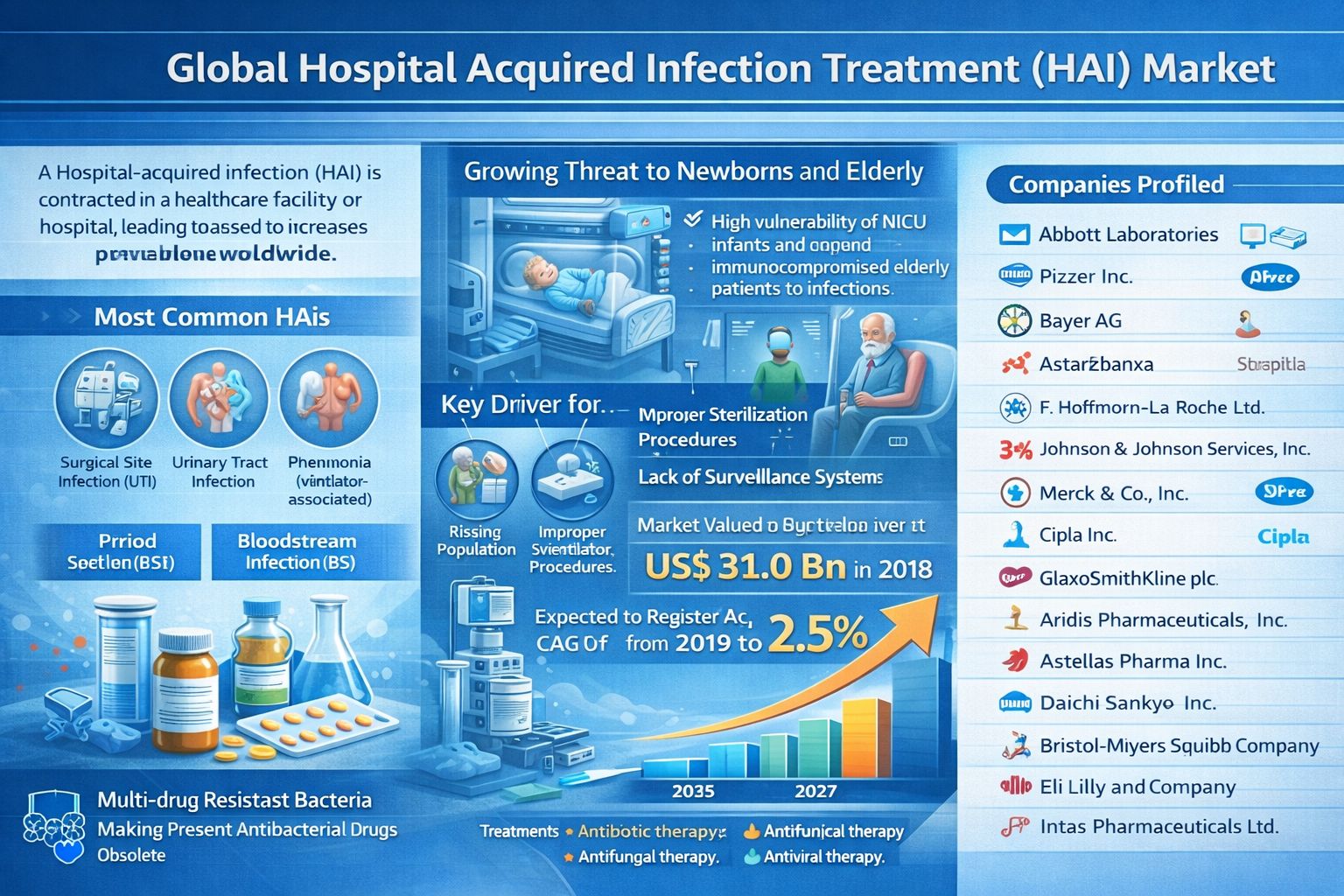
The global hospital-acquired infection (HAI) treatment market has been witnessing steady growth due to the increasing prevalence of infections within healthcare settings worldwide. According to Transparency Market Research, the market was valued at US$ 31.0 Bn in 2018 and is projected to expand at a CAGR of 2.5% from 2019 to 2027, reaching approximately US$ 38.8 Bn by 2027.
This moderate yet consistent growth trajectory reflects the ongoing need for effective infection control and treatment solutions, particularly in hospitals, long-term care facilities, and specialized units such as intensive care units (ICUs) and neonatal intensive care units (NICUs).
→Discover Market Opportunities – Request Your Sample Copy Now: https://www.transparencymarketresearch.com/sample/sample.php?flag=S&rep_id=17267
Market Overview
Hospital-acquired infections, also referred to as nosocomial infections or healthcare-associated infections, are infections that patients acquire during their stay in healthcare facilities. These infections may not be present or incubating at the time of admission but develop during or after hospitalization.
HAIs are primarily caused by bacterial, viral, and fungal pathogens, with common types including:
- Surgical Site Infections (SSI)
- Urinary Tract Infections (UTI)
- Pneumonia (especially ventilator-associated pneumonia)
- Bloodstream Infections (BSI)
Treatment approaches for HAIs involve a combination of antifungal therapies, antiviral medications, and antibacterial drugs, depending on the causative organism.
The growing burden of HAIs, coupled with their high transmissibility and delayed manifestation—even weeks after discharge—has significantly increased the demand for advanced treatment solutions globally.
Key Market Growth Drivers
Rising Geriatric Population
One of the primary drivers of the HAI treatment market is the rapid increase in the global geriatric population. Elderly individuals are more susceptible to infections due to immunosenescence, a natural decline in immune function with age.
According to global estimates, the geriatric population is expected to reach 2 billion by 2050, up from 566 million currently, accounting for nearly 22% of the global population. This demographic shift is leading to longer hospital stays and a higher risk of infection, thereby increasing the demand for HAI treatments.
Vulnerability of Neonates
Newborns, particularly those in NICUs, represent a highly vulnerable group. Studies by the National Institute of Child Health and Human Development (NICHD) indicate:
- 29% of infants born at 25–28 weeks gestation develop severe HAIs
- 46% of infants born before 25 weeks are affected
This high susceptibility significantly contributes to the expansion of the HAI treatment market.
Poor Hygiene and Sterilization Practices
Inadequate sterilization techniques and unhygienic conditions in healthcare facilities—especially in low- and middle-income countries—have led to a surge in infection rates. For instance, India alone reports over 190,000 neonatal deaths annually due to infections, highlighting the severity of the issue.
Lack of Surveillance Systems
Many developing regions lack standardized surveillance systems for tracking HAIs. Even in countries where such systems exist, inconsistencies in diagnostic criteria and reporting create challenges. This gap has resulted in increased infection rates, thereby boosting the demand for treatment solutions.
Analysis of Key Players – Key Player Strategies
The global HAI treatment market is highly fragmented, with numerous multinational and regional players competing through innovation and strategic initiatives.
Leading companies include:
- Pfizer Inc.
- Abbott Laboratories
- Bayer AG
- AstraZeneca
- F. Hoffmann-La Roche Ltd.
- Johnson & Johnson Services, Inc.
- Merck & Co., Inc.
- Cipla Inc.
- GlaxoSmithKline plc
Key Strategies Adopted by Players
- Product innovation and pipeline expansion
- Strategic collaborations and partnerships
- Mergers and acquisitions
- Focus on antimicrobial resistance solutions
- Expansion into emerging markets
These strategies are enabling companies to strengthen their global footprint and address the growing complexity of HAIs.
Market Challenges & Opportunities
Challenges
Multi-Drug Resistant (MDR) Bacteria
The rise of MDR bacteria such as:
- Methicillin-resistant Staphylococcus aureus (MRSA)
- Vancomycin-resistant Enterococcus (VRE)
- Multidrug-resistant tuberculosis (MDR-TB)
poses a significant challenge to existing treatment protocols. These pathogens reduce the effectiveness of conventional antibiotics, leading to higher mortality rates and increased healthcare costs.
High Treatment Costs
Advanced antimicrobial therapies and prolonged hospital stays significantly increase treatment expenses, limiting access in developing regions.
→Explore Strategies & Trends – Request Full Report Access – https://www.transparencymarketresearch.com/sample/sample.php?flag=S&rep_id=17267
Opportunities
Development of Novel Antimicrobials
There is a growing opportunity for pharmaceutical companies to invest in next-generation antibiotics and biologics to combat resistant strains.
Improved Infection Control Programs
The implementation of advanced sterilization technologies and surveillance systems presents opportunities for reducing infection rates and improving treatment outcomes.
Key Player Strategies
Key players are focusing on strengthening their market positions through:
- Regulatory approvals for new drugs
- Launch of advanced antimicrobial therapies
- Collaborative R&D initiatives
- Digital surveillance integration for infection tracking
Such strategies are expected to enhance treatment efficacy and expand market reach.
Recent Developments
- In July 2019, Pfizer Inc. completed acquisition of the privately-held clinical-stage biotechnology company Therachon Holding AG for US$ 340 Mn. Therachon represented the Rare Disease team of Pfizer to develop innovative medicines to treat rare diseases.
- In December 2018, Pfizer Inc. and GlaxoSmithKline plc entered into an agreement to create a premier global consumer health care company with iconic brands. In 2017, the combined business was approximately US$ 12.7 Bn.
These developments highlight the emphasis on innovation and strategic consolidation within the industry.
Investment Landscape and ROI Outlook
The HAI treatment market presents a stable investment opportunity due to its essential nature within healthcare systems. Key investment highlights include:
- Consistent demand driven by infection prevalence
- Growing need for antimicrobial innovation
- Opportunities in emerging markets with improving healthcare infrastructure
Return on investment (ROI) is expected to remain moderate but steady, supported by continuous advancements in drug development and rising healthcare expenditure globally.
Market Segmentations
By Treatment Type
- Antibacterial Drugs
- Antiviral Drugs
- Antifungal Drugs
By Infection Type
- Surgical Site Infections (SSI)
- Urinary Tract Infections (UTI)
- Pneumonia
- Bloodstream Infections
By Region
- North America: Dominates the market due to advanced healthcare infrastructure and high treatment costs
- Europe: Strong presence of surveillance systems and regulatory frameworks
- Asia Pacific: Rapid growth due to increasing infection rates and improving healthcare access
- Latin America & Middle East & Africa: Emerging markets with rising awareness and investment
North America holds the largest share, while Asia Pacific is expected to witness the fastest growth during the forecast period.
Why Buy This Report?
- Gain detailed insights into market size, growth trends, and forecasts
- Understand key drivers, challenges, and opportunities shaping the market
- Analyze competitive landscape and company strategies
- Identify investment opportunities and emerging regions
- Access comprehensive segmentation and regional analysis
This report is essential for stakeholders aiming to make informed strategic decisions in the global HAI treatment market.
FAQs
- What is the total market value of the hospital-acquired infection treatment market?
The market is projected to reach US$ 38.8 Bn by 2027, up from US$ 31.0 Bn in 2018.
- What is the expected CAGR of the market?
The market is anticipated to grow at a CAGR of 2.5% from 2019 to 2027.
- What are the major growth drivers?
Key drivers include:
- Rising geriatric population
- Increasing neonatal vulnerability
- Poor hygiene and sterilization practices
- Lack of surveillance systems
- Which region dominates the global market?
North America holds the largest market share due to advanced healthcare systems and high treatment costs.
- Who are the leading players in the market?
Major players include Abbott Laboratories, Pfizer Inc., Bayer AG, AstraZeneca, and Merck & Co., Inc..
Buy Full Report Now: https://www.transparencymarketresearch.com/checkout.php?rep_id=17267<ype=S
→Explore Latest Research Reports by Transparency Market Research:
Beta Blockers Market: https://www.transparencymarketresearch.com/beta-blockers-market.html
Egypt Cardiovascular Drugs Market: https://www.transparencymarketresearch.com/egypt-cardiovascular-drugs-market.html
Vaccines Market: https://www.transparencymarketresearch.com/global-vaccine-market.html
About Transparency Market Research
Transparency Market Research, a global market research company registered at Wilmington, Delaware, United States, provides custom research and consulting services. Our exclusive blend of quantitative forecasting and trends analysis provides forward-looking insights for thousands of decision makers. Our experienced team of Analysts, Researchers, and Consultants use proprietary data sources and various tools & techniques to gather and analyses information.
Our data repository is continuously updated and revised by a team of research experts, so that it always reflects the latest trends and information. With a broad research and analysis capability, Transparency Market Research employs rigorous primary and secondary research techniques in developing distinctive data sets and research material for business reports.



Leave a Reply