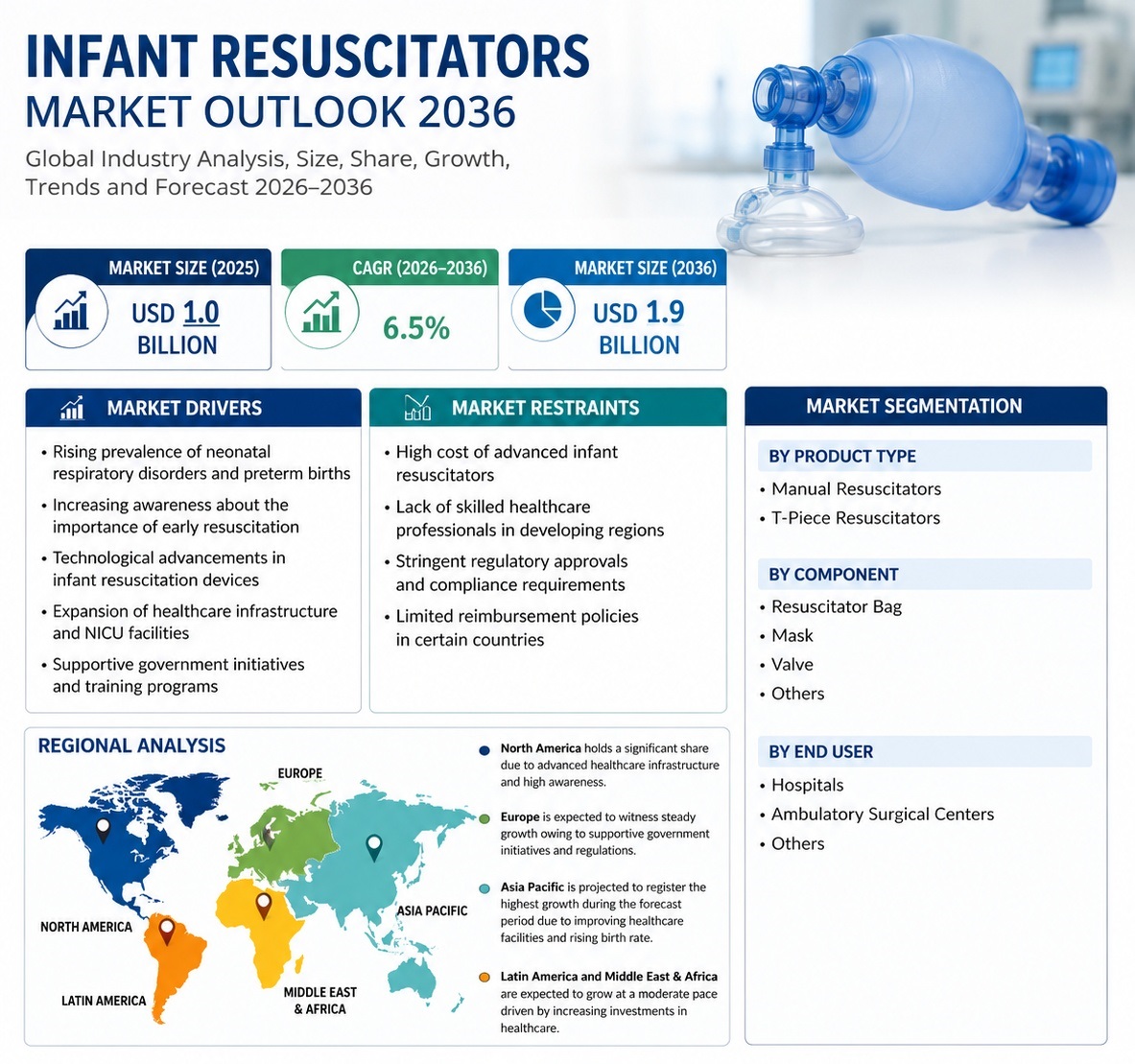
The global Infant Resuscitators Market is witnessing steady growth as healthcare providers increasingly prioritize neonatal survival and emergency respiratory care. Infant resuscitators are critical medical devices used to provide immediate breathing support to newborns experiencing respiratory distress during or immediately after delivery. These devices play an essential role in reducing neonatal mortality associated with birth asphyxia, prematurity, infections, and delayed adaptation. Growing awareness regarding maternal and infant healthcare, expanding neonatal intensive care infrastructure, and continuous advancements in respiratory support technologies are expected to support long-term market growth through 2036.
👉 Get sample market research report copy now@ https://www.transparencymarketresearch.com/sample/sample.php?flag=S&rep_id=64841
Market Overview
The global Infant Resuscitators Market was valued at USD 1.0 Billion in 2025 and is projected to reach USD 1.9 Billion by 2036, registering a CAGR of 6.5% during the forecast period. Increasing institutional births, improved neonatal healthcare services, and greater availability of advanced respiratory support equipment are driving market expansion. North America accounted for the largest revenue share of 36% in 2025, while the T-piece Resuscitator segment dominated the product category with approximately 43% of total market revenue. Market participants continue to invest in product innovation, expanding distribution networks, and strategic partnerships to strengthen their global presence.
Key Drivers of Market Growth
One of the primary drivers of the Infant Resuscitators Market is the growing incidence of preterm births and neonatal respiratory complications requiring immediate medical intervention. Newborns suffering from birth asphyxia, respiratory distress syndrome, infections, or delayed breathing often require prompt ventilation support, increasing demand for reliable resuscitation devices across hospitals and neonatal intensive care units.
Another significant growth factor is the increasing focus on emergency preparedness in maternity hospitals and healthcare facilities. Healthcare providers are investing in advanced neonatal resuscitation equipment and training healthcare professionals to improve emergency response during childbirth. Continuous monitoring of neonatal mortality by global health organizations has further encouraged governments to strengthen newborn care infrastructure.
Technological improvements are also contributing to market growth. Manufacturers are introducing resuscitators featuring precise pressure control, improved oxygen delivery, ergonomic designs, disposable breathing circuits, and enhanced safety mechanisms. These innovations improve clinical outcomes while minimizing the risk of lung injury among newborns.
Key Players and Industry Leaders
The Infant Resuscitators Market remains moderately competitive with several established medical device manufacturers focusing on neonatal respiratory care solutions. Leading companies include Ambu A/S, Fisher & Paykel Healthcare, Laerdal, Flexicare (Group) Limited, Besmed, Nice Neotech Medical Systems, Zeal Medical, Kaycoindia (Kay & Company), and Pigeon Medical.
These companies continue investing in research and development to introduce efficient, user-friendly, and portable infant resuscitation devices. Strategic collaborations, product launches, expansion into emerging healthcare markets, and broader distribution networks remain key competitive strategies. Recent developments include Besmed’s participation in FIME 2026, Flexicare’s NeoPIP Infant Resuscitator product recognition, and Laerdal’s partnership with the WHO Foundation to expand emergency care training programs.
Key Trends for the Future
Several emerging trends are expected to shape the future of the Infant Resuscitators Market. Healthcare providers are increasingly adopting pressure-controlled ventilation systems that provide consistent positive airway pressure while reducing ventilation-related complications. T-piece resuscitators are gaining widespread acceptance because they offer improved control of Peak Inspiratory Pressure (PIP) and Positive End Expiratory Pressure (PEEP).
Another important trend is the growing demand for portable and disposable resuscitation devices, particularly in emergency transport services, rural healthcare facilities, and resource-limited settings. Manufacturers are also integrating lightweight materials, simplified operation, and improved infection control features into their products.
Growing investments in neonatal intensive care units (NICUs), maternal healthcare infrastructure, simulation-based clinical training, and digital monitoring technologies are expected to further enhance product adoption worldwide.
Explore our report to uncover in-depth insights – https://www.transparencymarketresearch.com/infant-resuscitators-market.html
New Opportunities and Challenges
Significant growth opportunities exist in low-resource healthcare settings where access to neonatal resuscitation equipment remains limited. Expanding maternal and child healthcare programs, increasing institutional deliveries, and government investments in rural healthcare infrastructure are creating substantial demand for affordable, durable, and easy-to-operate infant resuscitators.
Manufacturers also have opportunities to develop reusable devices, compact emergency kits, neonatal masks, training mannequins, and cost-effective ventilation systems suitable for hospitals with limited resources.
Despite positive growth prospects, the market faces several challenges. High equipment costs, unequal healthcare infrastructure across developing countries, limited access to skilled neonatal care professionals, and regulatory compliance requirements may restrict adoption. Additionally, maintaining consistent product quality while ensuring affordability remains a major challenge for manufacturers targeting emerging economies.
Market Trends & Innovations
Innovation remains a major focus within the Infant Resuscitators Market. Companies are developing advanced T-piece resuscitators capable of delivering highly controlled ventilation while minimizing the risk of neonatal lung injury. Improvements in oxygen blending technology, pressure-limiting valves, disposable breathing circuits, and ergonomic mask designs continue enhancing patient safety.
Manufacturers are also emphasizing compact product designs suitable for emergency transport, ambulances, delivery rooms, and rural healthcare centers. Increasing adoption of simulation-based training programs for healthcare professionals further supports effective utilization of neonatal resuscitation equipment. These innovations contribute to improved clinical outcomes and greater confidence among healthcare providers.
Future Outlook
The Infant Resuscitators Market is expected to maintain stable growth through 2036, supported by rising awareness of neonatal healthcare, increasing preterm births, expanding NICU infrastructure, and continuous product innovation. Growing government initiatives focused on reducing infant mortality and improving maternal healthcare services will further strengthen market demand.
Emerging economies across Asia-Pacific, Latin America, the Middle East, and Africa are expected to generate significant growth opportunities as healthcare accessibility improves and investments in neonatal care continue increasing. Companies focusing on affordability, technological innovation, and broader product availability are likely to gain competitive advantages in these rapidly developing markets.
Market Segmentation
By Product Type
- Self-inflating Resuscitator
- Flow-inflating Resuscitator
- T-piece Resuscitator
By Type
- Reusable
- Disposable
By End-user
- Hospitals
- Neonatal Care Centers
- Others
By Region
- North America
- Europe
- Asia-Pacific
- Latin America
- Middle East & Africa
👉 To buy this comprehensive market research report, click here to inquire@ https://www.transparencymarketresearch.com/checkout.php?rep_id=64841<ype=S
Important FAQs with Answers
- What is driving the growth of the Infant Resuscitators Market?
The market is driven by rising preterm births, increasing neonatal respiratory complications, expanding NICU infrastructure, and greater awareness of newborn emergency care. - What was the market size in 2025?
The global Infant Resuscitators Market was valued at USD 1.0 Billion in 2025. - What is the projected market value by 2036?
The market is expected to reach USD 1.9 Billion by 2036. - Which product segment leads the market?
The T-piece Resuscitator segment held the largest market share of approximately 43% in 2025. - Which region dominates the market?
North America accounted for the highest market share, contributing approximately 36% of global revenue in 2025.
More Trending Reports by Transparency Market Research –
Pulmonary Drug Delivery Devices Market
About Transparency Market Research
Transparency Market Research, a global market research company registered at Wilmington, Delaware, United States, provides custom research and consulting services. Our exclusive blend of quantitative forecasting and trends analysis provides forward-looking insights for thousands of decision makers. Our experienced team of Analysts, Researchers, and Consultants use proprietary data sources and various tools & techniques to gather and analyses information.
Our data repository is continuously updated and revised by a team of research experts, so that it always reflects the latest trends and information. With a broad research and analysis capability, Transparency Market Research employs rigorous primary and secondary research techniques in developing distinctive data sets and research material for business reports.
Media Contact:
Abhishek Budholiya
Transparency Market Research Inc.
State Tower, 90 State Street, Suite 700,
Albany NY – 12207, United States
Tel: +1-518-618-1030
USA – Canada Toll Free: 866-552-3453
Website: https://www.transparencymarketresearch.com
Sales Inquiries: sales@transparencymarketresearch.com
Media Inquiries: media@transparencymarketresearch.com




Leave a Reply