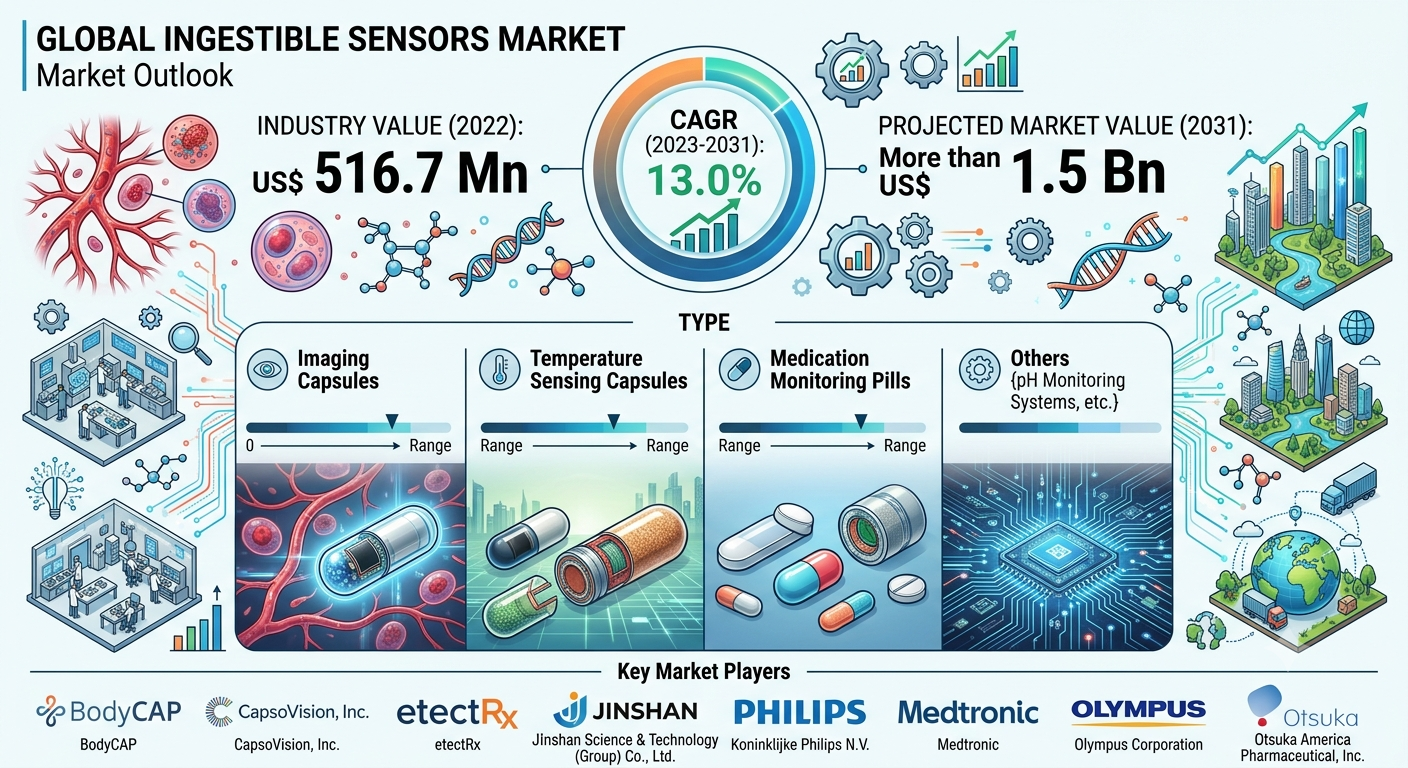
The global ingestible sensors market is witnessing robust growth, fueled by rapid advancements in digital healthcare, miniaturized medical devices, and personalized medicine. The market was valued at US$ 516.7 million in 2022 and is projected to exceed US$ 1.5 billion by 2031, expanding at a compound annual growth rate (CAGR) of 13.0% during the forecast period from 2023 to 2031. Rising demand for non-invasive diagnostic technologies, continuous patient monitoring, and data-driven healthcare solutions is encouraging healthcare providers and medical device manufacturers to invest heavily in ingestible sensor technologies. As the healthcare industry increasingly focuses on early disease detection and remote patient monitoring, ingestible sensors are emerging as an essential component of next-generation digital medicine.
Review significant findings and insights from our Report in this sample –
https://www.transparencymarketresearch.com/sample/sample.php?flag=S&rep_id=15323
Market Overview
Ingestible sensors are miniature electronic devices that can be swallowed like conventional capsules to monitor physiological conditions inside the human body. Equipped with cameras, temperature sensors, pressure sensors, pH sensors, and wireless communication technologies, these devices capture valuable clinical information as they travel through the gastrointestinal tract. The collected data is transmitted to external receivers, allowing healthcare professionals to monitor organ function, diagnose gastrointestinal disorders, evaluate medication adherence, and assess overall patient health without requiring invasive procedures.
The market includes imaging capsules, temperature sensing capsules, medication monitoring pills, and other specialized sensor systems such as pH monitoring devices. These technologies are widely used in hospitals, diagnostic centers, research institutions, and sports performance monitoring. The growing adoption of digital healthcare platforms, combined with advances in wireless communication, battery technology, flexible electronics, and sensor miniaturization, is expanding the range of applications for ingestible sensors across medical and non-medical sectors.
Key Market Growth Drivers
Continuous advancements in miniaturization technology represent one of the most significant drivers of the ingestible sensors market. Improvements in semiconductor manufacturing, nanotechnology, flexible electronics, and low-power wireless communication have enabled manufacturers to significantly reduce the size of sensors, processors, batteries, and communication modules. Modern ingestible sensors are considerably smaller, more comfortable, and more biocompatible than earlier generations, allowing them to move safely through the digestive tract while collecting detailed physiological data. Enhanced miniaturization also enables simultaneous monitoring of multiple biomarkers, expanding diagnostic capabilities and improving patient outcomes.
The growing adoption of personalized medicine is another major factor accelerating market growth. Healthcare providers are increasingly relying on patient-specific clinical data to optimize treatment plans and improve therapeutic outcomes. Ingestible sensors generate continuous physiological information related to gastrointestinal function, medication metabolism, nutritional absorption, and organ performance, enabling physicians to tailor treatments according to individual patient needs. The integration of sensor-generated data with genomic analysis and digital health platforms further enhances clinical decision-making and supports proactive disease management. Increasing demand for remote patient monitoring, preventive healthcare, and digital therapeutics is expected to sustain strong market growth throughout the forecast period.
Analysis of Key Players – Key Player Strategies
The global ingestible sensors market is moderately fragmented, with several established medical device manufacturers and innovative technology companies competing through product innovation, strategic partnerships, and technological advancements. Prominent companies operating in the market include BodyCAP, CapsoVision, Inc., etectRx, JINSHAN Science & Technology (Group) Co., Ltd., Koninklijke Philips N.V., Medtronic, Olympus Corporation, and Otsuka America Pharmaceutical, Inc.
Leading market participants are prioritizing investments in research and development to improve sensor accuracy, battery performance, wireless connectivity, and patient comfort. Strategic collaborations between pharmaceutical companies and sensor technology developers are becoming increasingly common as organizations seek to integrate digital therapeutics with medication adherence monitoring. Companies are also expanding their product portfolios by introducing advanced capsule endoscopy systems, smart medication monitoring solutions, and AI-enabled diagnostic platforms. Regulatory approvals, product launches, acquisitions, and collaborations with healthcare providers continue to strengthen market competitiveness while accelerating commercialization of next-generation ingestible sensor technologies.
Market Challenges & Opportunities
Despite its promising outlook, the ingestible sensors market faces several challenges. The high cost of advanced ingestible sensor technologies, complex regulatory approval processes, and concerns regarding patient data privacy and cybersecurity may limit broader adoption. Additionally, reimbursement policies for emerging digital health technologies vary across countries, creating barriers to commercialization in certain healthcare systems. Technical challenges related to battery life, wireless signal transmission, and device reliability also remain areas requiring continued innovation.
However, the market offers substantial opportunities as healthcare systems increasingly embrace digital transformation and personalized medicine. Expanding applications beyond gastrointestinal diagnostics into medication adherence monitoring, chronic disease management, and sports performance optimization are expected to create new revenue streams. Growing demand for remote patient monitoring, increasing investments in digital therapeutics, and ongoing advances in artificial intelligence, biosensors, and wireless healthcare technologies will further enhance market opportunities. Collaborations between pharmaceutical companies and medical device manufacturers are also expected to accelerate the development of intelligent drug delivery systems and next-generation smart pills.
Investment Landscape and ROI Outlook
The investment landscape for the ingestible sensors market remains highly attractive due to strong technological innovation and expanding applications in digital healthcare. Venture capital firms, medical technology companies, pharmaceutical manufacturers, and healthcare organizations are investing significantly in sensor miniaturization, AI-enabled diagnostics, remote monitoring platforms, and digital therapeutics. These investments are supported by increasing healthcare expenditure, favorable regulatory initiatives promoting digital health, and growing demand for non-invasive diagnostic technologies.
From an investment perspective, ingestible sensors offer strong long-term return on investment by improving diagnostic accuracy, reducing hospitalization costs, minimizing invasive procedures, and enhancing patient outcomes. Companies that successfully develop highly accurate, cost-effective, and scalable sensor technologies are expected to benefit from increasing adoption across hospitals, specialty clinics, pharmaceutical companies, and remote healthcare programs. The continued integration of ingestible sensors with cloud-based healthcare platforms and personalized treatment models is expected to further strengthen commercial opportunities during the forecast period.
Market Segmentations
The global ingestible sensors market is segmented by type into imaging capsules, temperature sensing capsules, medication monitoring pills, and other ingestible sensor systems, including pH monitoring devices and constipation management solutions. Imaging capsules currently dominate the market due to their widespread use in capsule endoscopy and non-invasive gastrointestinal diagnostics.
Based on end-use industry, the market is categorized into healthcare and medical applications, sports and fitness, and other emerging applications. Healthcare remains the largest end-use segment due to increasing demand for gastrointestinal diagnostics, medication adherence monitoring, and chronic disease management. The sports and fitness segment is expected to register the fastest growth during the forecast period as athletes and fitness professionals increasingly utilize ingestible sensors to monitor hydration, body temperature, electrolyte balance, recovery, and overall physiological performance in real time.
From a regional perspective, North America holds the largest share of the global market owing to its advanced healthcare infrastructure, early adoption of innovative medical technologies, favorable reimbursement policies, and strong regulatory support. Europe represents the second-largest regional market, driven by government investments in healthcare innovation, expanding digital health initiatives, and growing commercialization of advanced medical devices. Asia Pacific is expected to witness the fastest growth during the forecast period, supported by rising healthcare expenditure, expanding patient populations, improving healthcare accessibility, and increasing investments in medical technology across countries such as China, Japan, South Korea, and India. Latin America and the Middle East & Africa are also expected to experience steady growth as healthcare infrastructure and awareness of advanced diagnostic technologies continue to improve.
Why Buy This Report?
This report provides a comprehensive assessment of the global ingestible sensors market by analyzing market size, future growth prospects, technological innovations, competitive dynamics, regional developments, and investment opportunities. It offers detailed insights into key growth drivers, market challenges, emerging trends, product innovations, and strategic initiatives undertaken by leading industry participants. The report also includes extensive segmentation analysis across product types, end-use industries, and geographic regions, enabling stakeholders to identify emerging opportunities and formulate effective business strategies. It serves as a valuable resource for medical device manufacturers, pharmaceutical companies, healthcare providers, investors, research organizations, and policymakers seeking accurate market intelligence to support strategic planning and investment decisions.
FAQs
What is the projected value of the global ingestible sensors market by 2031?
The global ingestible sensors market is projected to exceed US$ 1.5 billion by 2031, growing from US$ 516.7 million in 2022 at a CAGR of 13.0%.
Which region dominates the ingestible sensors market?
North America currently dominates the global ingestible sensors market due to its advanced healthcare infrastructure, strong regulatory support, favorable reimbursement environment, and early adoption of innovative medical technologies.
Which product segment holds the largest market share?
Imaging capsules account for the largest share of the market, supported by their widespread use in non-invasive capsule endoscopy and gastrointestinal disease diagnosis.
What factors are driving market growth?
Key growth drivers include advancements in miniaturization technology, increasing adoption of personalized medicine, growing demand for non-invasive diagnostic procedures, expanding remote patient monitoring, and rising collaborations between pharmaceutical companies and digital health technology providers.
Who are the leading companies operating in the ingestible sensors market?
Major companies operating in the market include BodyCAP, CapsoVision, Inc., etectRx, JINSHAN Science & Technology (Group) Co., Ltd., Koninklijke Philips N.V., Medtronic, Olympus Corporation, and Otsuka America Pharmaceutical, Inc.
Buy this Premium Research Report and access vital insights and analysis –
https://www.transparencymarketresearch.com/checkout.php?rep_id=15323<ype=S
More Trending Reports by Transparency Market Research –
GCC Countries Vertical Lift Module Market
Computed Tomography (CT) Market
Atomic Force Microscopes (AFM) Market
About Transparency Market Research
Transparency Market Research, a global market research company registered at Wilmington, Delaware, United States, provides custom research and consulting services. Our exclusive blend of quantitative forecasting and trends analysis provides forward-looking insights for thousands of decision makers. Our experienced team of Analysts, Researchers, and Consultants use proprietary data sources and various tools & techniques to gather and analyses information.
Our data repository is continuously updated and revised by a team of research experts, so that it always reflects the latest trends and information. With a broad research and analysis capability, Transparency Market Research employs rigorous primary and secondary research techniques in developing distinctive data sets and research material for business reports.
Media Contact:
Abhishek Budholiya
Transparency Market Research Inc.
State Tower, 90 State Street, Suite 700,
Albany NY – 12207, United States
Tel: +1-518-618-1030
USA – Canada Toll Free: 866-552-3453
Website: https://www.transparencymarketresearch.com
Sales Inquiries: sales@transparencymarketresearch.com
Media Inquiries: media@transparencymarketresearch.com




Leave a Reply