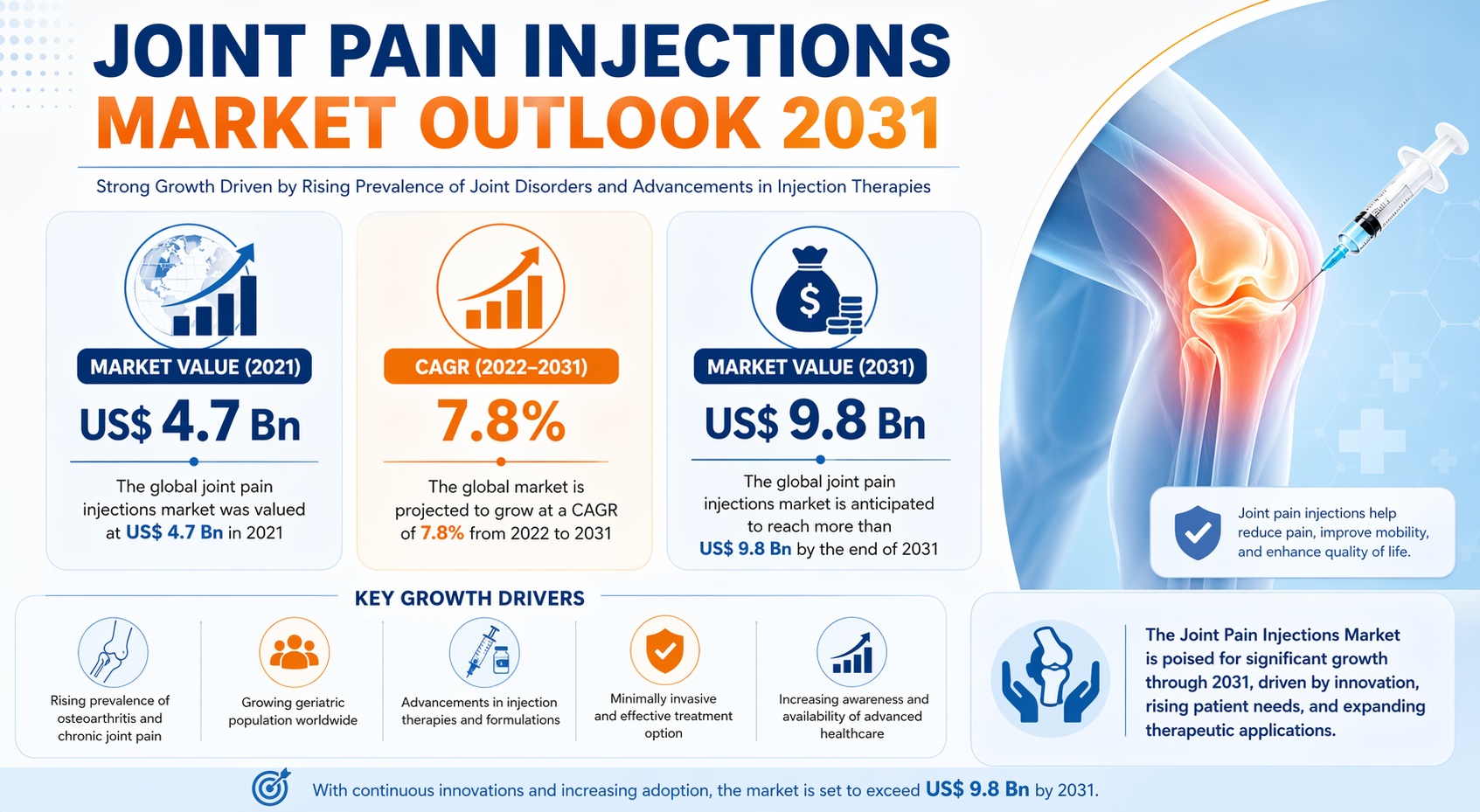
The global joint pain injections market is witnessing strong expansion due to rising musculoskeletal disorders, increasing geriatric population, and growing demand for minimally invasive pain management therapies. The market was valued at US$ 4.7 Bn in 2021 and is projected to surpass US$ 9.8 Bn by 2031, expanding at a CAGR of 7.8% from 2022 to 2031.
Growing prevalence of osteoarthritis, rheumatoid arthritis, and sports-related injuries is accelerating the demand for advanced injectable therapies such as corticosteroids, hyaluronic acid, and regenerative biologics.
Access key findings and insights from our Report in this sample –
https://www.transparencymarketresearch.com/sample/sample.php?flag=S&rep_id=47664
Market Overview
Joint pain injections are medical treatments administered directly into affected joints to reduce inflammation, improve mobility, and manage chronic pain conditions. These injections are widely used for conditions affecting the knee, hip, shoulder, elbow, and spinal facet joints.
The market is evolving rapidly due to:
- Rising demand for non-surgical pain relief
- Advancements in viscosupplementation therapies
- Increased adoption of biologics such as platelet-rich plasma (PRP)
- Growing awareness of early-stage arthritis management
These factors are transforming joint injections into a preferred therapeutic option for long-term musculoskeletal care.
Key Market Growth Drivers
1. Rising Prevalence of Arthritis and Joint Disorders
Osteoarthritis is one of the most common causes of disability worldwide. Aging populations are significantly increasing patient pools requiring joint pain management solutions.
2. Growing Geriatric Population
Older individuals are more prone to degenerative joint diseases, significantly increasing demand for injectable therapies that improve mobility and quality of life.
3. High Unmet Medical Needs
Existing treatment options primarily focus on pain relief rather than disease reversal, creating strong demand for more effective injectable solutions.
4. Increasing Preference for Minimally Invasive Treatments
Patients increasingly prefer injections over surgical interventions due to lower risk, shorter recovery time, and reduced hospitalization.
5. Advancements in Orthobiologics
Innovations such as platelet-rich plasma (PRP) and tissue-based injections are enhancing treatment outcomes and expanding therapeutic applications.
6. Expanding Insurance Coverage and Healthcare Access
Improved reimbursement policies in developed markets are boosting patient adoption of advanced injection therapies.
Market Size
- Market Value (2021): US$ 4.7 Bn
- Forecast Value (2031): More than US$ 9.8 Bn
- CAGR (2022–2031): 7.8%
The market is expected to nearly double over the forecast period due to increasing clinical adoption and product innovation.
Analysis of Key Players – Key Player Strategies
The global joint pain injections market is moderately consolidated with strong competition among pharmaceutical and biotech companies.
Key Players:
- Allergan plc
- Pfizer, Inc.
- Sanofi
- Anika Therapeutics, Inc.
- Ferring B.V.
- Bioventus
- Flexion Therapeutics, Inc.
- Zimmer Biomet Holdings, Inc.
- Seikagaku Corporation
- Chugai Pharmaceutical Co., Ltd.
Strategic Focus Areas:
1. Product Innovation and R&D Investment
Companies are heavily investing in biologics, regenerative medicine, and long-acting formulations.
2. Expansion of Hyaluronic Acid-Based Products
Hyaluronic acid injections are gaining traction due to effectiveness in osteoarthritis treatment.
3. Strategic Collaborations and Partnerships
Pharma companies are partnering with biotech firms to develop next-generation injectable therapies.
4. Mergers and Acquisitions
Acquisition strategies are being used to expand portfolios and gain access to advanced technologies.
5. Geographic Expansion
Companies are targeting Asia Pacific and Latin America for growth due to large untreated patient populations.
Market Challenges & Opportunities
Challenges:
- High treatment cost of advanced biologic injections
- Limited disease-modifying therapies for arthritis
- Regulatory hurdles for new injectable biologics
- Potential side effects and variability in patient response
Opportunities:
- Rising demand for PRP and regenerative therapies
- Expansion in emerging economies
- Increasing adoption of outpatient injection procedures
- Growing focus on personalized orthopedic treatment
- Technological advancements in drug delivery systems
Key Player Strategies
Market participants are focusing on:
- Expanding biologics and hyaluronic acid portfolios
- Enhancing clinical trial pipelines for osteoarthritis therapies
- Strengthening distribution through hospital and specialty clinics
- Developing long-acting and single-dose injection solutions
- Targeting underserved orthopedic patient populations
Recent Developments (as per report)
- In September 2021, Novartis announced that the U.S. Food and Drug Administration (FDA) had granted LNA043 Fast Track Designation for the treatment of osteoarthritis of the knee
- In July 2017, South Korea’s Ministry of Food and Drug Safety approved the first gene therapy for OA developed by TissueGene, a Maryland-based company
- In March 2017, Bristol-Myers Squibb entered into a collaboration with CytomX Therapeutics, Inc., a leading biopharmaceutical company. This collaboration was aimed toward the development of novel therapies with eight additional targets for probody therapeutics.
Investment Landscape and ROI Outlook
The joint pain injections market offers strong investment potential due to:
- Increasing global arthritis prevalence
- Expanding biologics and regenerative medicine pipeline
- Strong recurring demand from chronic patients
- High procedural adoption in outpatient care settings
ROI Outlook:
Investments in hyaluronic acid, PRP, and next-generation biologic injections are expected to yield strong long-term returns due to repeat treatments and expanding patient pools.
Healthcare investors and pharmaceutical companies are increasingly prioritizing orthobiologic portfolios as part of long-term growth strategies.
Market Segmentations
By Joint Type:
- Knee & Ankle
- Hip Joint
- Shoulder & Elbow
- Facet Joints of Spine
- Others
By Injection Type:
- Corticosteroid Injections
- Hyaluronic Acid Injections
- Others
By Distribution Channel:
- Hospital Pharmacies
- Retail Pharmacies
- Online Pharmacies
By Region:
- North America (dominant market)
- Europe (second largest)
- Asia Pacific (fastest growing)
- Latin America
- Middle East & Africa
Country Coverage:
- U.S., Canada
- Germany, U.K., France, Spain, Italy
- China, Japan, India
- Australia & New Zealand
- Brazil, Mexico
- GCC countries
- South Africa
Why Buy This Report?
- Comprehensive 2022–2031 market forecast analysis
- Detailed segmentation by joint type, injection type, and region
- Competitive landscape with key player profiling
- Insights into biologics and hyaluronic acid growth trends
- Investment and ROI analysis for stakeholders
- Regulatory and clinical adoption trends
- Emerging opportunities in regenerative orthopedics
FAQs
1. What is the size of the global joint pain injections market?
The market was valued at US$ 4.7 Bn in 2021 and is projected to exceed US$ 9.8 Bn by 2031.
2. What is the growth rate of the market?
The market is expected to grow at a CAGR of 7.8% from 2022 to 2031.
3. What are the key drivers of the market?
Rising arthritis prevalence, aging population, unmet medical needs, and advancements in biologic therapies are key drivers.
4. Which injection type dominates the market?
Hyaluronic acid injections dominate due to strong effectiveness in osteoarthritis treatment.
5. Which region leads the market?
North America leads the global market, while Asia Pacific is expected to grow the fastest.



Leave a Reply