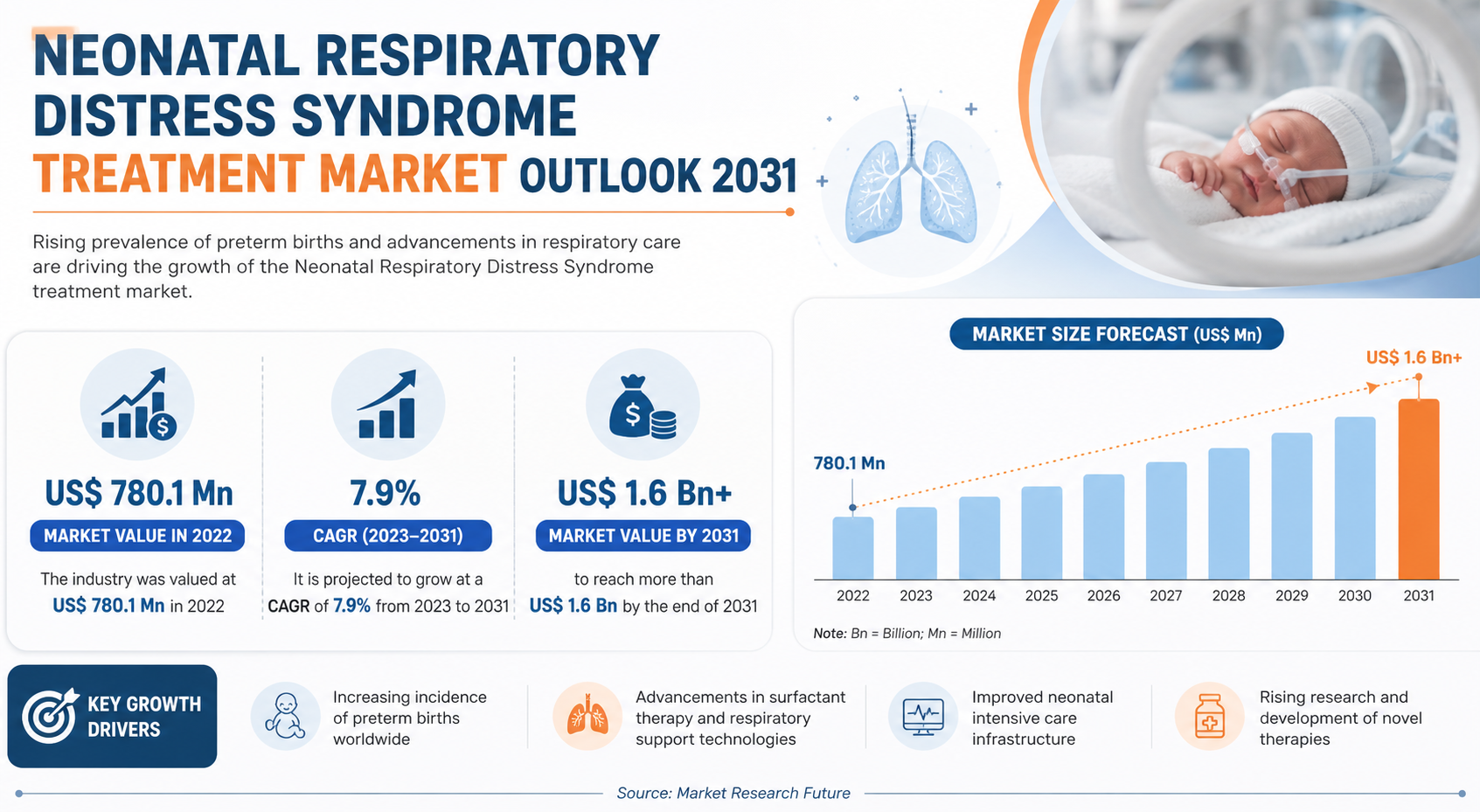
The global Neonatal Respiratory Distress Syndrome (NRDS) Treatment Market is experiencing steady and meaningful expansion, driven by rising cases of premature births, rapid advancements in neonatal intensive care technologies, and increasing global awareness of neonatal health conditions. The market, valued at US$ 780.1 million in 2022, is projected to exceed US$ 1.6 billion by 2031, growing at a CAGR of 7.9% from 2023 to 2031.
Market Size
The neonatal respiratory distress syndrome treatment market demonstrates strong growth potential due to rising neonatal care needs worldwide.
- Market Size (2022): US$ 780.1 Million
- Forecast Market Size (2031): More than US$ 1.6 Billion
- CAGR (2023–2031): 7.9%
Growth is supported by increasing adoption of advanced respiratory support systems and surfactant therapies in neonatal intensive care units (NICUs). Rising investments in healthcare infrastructure, particularly in emerging economies, are further accelerating market expansion.
Market Overview
Neonatal Respiratory Distress Syndrome (NRDS) is a life-threatening condition primarily affecting premature infants whose lungs are underdeveloped and lack sufficient surfactant. This deficiency leads to breathing difficulties, low oxygen levels, and, if untreated, severe complications such as brain damage or mortality.
The NRDS treatment market includes a range of medical interventions such as:
- Oxygen therapy
- Surfactant replacement therapy
- Mechanical ventilation
- Continuous Positive Airway Pressure (CPAP)
- Extracorporeal membrane oxygenation (ECMO)
The market is increasingly shifting toward advanced, less invasive respiratory support systems that improve survival rates while minimizing lung injury in newborns.
Key Market Growth Drivers
1. Rising Incidence of Premature Births
Premature birth is the leading cause of NRDS. Globally, around 15 million babies are born prematurely each year, significantly increasing demand for neonatal respiratory treatments.
In the United States alone, preterm birth rates rose from 10.1% in 2020 to 10.5% in 2021, highlighting the growing clinical burden on neonatal care systems.
2. Advancements in Neonatal Care Technologies
Technological improvements in NICU equipment and treatment methods have significantly improved survival rates.
Key advancements include:
- Volume-targeted ventilators reducing lung injury risk
- Improved surfactant delivery systems
- Advanced monitoring devices for real-time respiratory assessment
These innovations are enabling better outcomes and reducing long-term complications in premature infants.
3. Increasing Healthcare Investments
Governments and private healthcare providers are investing heavily in neonatal care infrastructure, particularly in developing regions such as Asia Pacific and Latin America. This is improving access to specialized NRDS treatment facilities.
4. Rising Awareness of Neonatal Health
Increased awareness among healthcare providers and parents regarding early diagnosis and treatment of NRDS is contributing to faster intervention rates and improved survival outcomes.
Analysis of Key Players – Key Player Strategies
The NRDS treatment market is highly competitive, with leading global medical device and pharmaceutical companies actively investing in innovation.
Major Companies Include:
- Medtronic
- Drägerwerk AG & Co. KGaA
- GE HealthCare
- Koninklijke Philips N.V.
- Smiths Medical (ICU Medical, Inc.)
- Fisher & Paykel Healthcare Limited
- Windtree Therapeutics Inc.
- Synthetic Biologics
- Synairgen
- IBIO, Inc.
Key Player Strategies
1. Product Innovation and R&D Investment
Companies are focusing on developing advanced respiratory support systems and surfactant formulations to improve neonatal survival rates.
2. Expansion of NICU Solutions
Manufacturers are enhancing neonatal intensive care offerings, including ventilators, oxygen delivery systems, and monitoring technologies.
3. Strategic Collaborations
Firms are partnering with hospitals, research institutes, and government health agencies to accelerate clinical adoption of new therapies.
4. Geographic Expansion
Key players are expanding into emerging markets where premature birth rates are high and healthcare infrastructure is improving.
5. Digital and AI Integration
Integration of artificial intelligence in neonatal monitoring systems is enabling real-time decision-making and improved clinical outcomes.
Market Challenges & Opportunities
Challenges
Despite strong growth, the market faces several limitations:
- Shortage of trained neonatal healthcare professionals
- Limited availability of advanced NICU facilities in low-income regions
- High cost of advanced neonatal treatment technologies
- Unequal access to healthcare infrastructure across regions
Opportunities
The market offers significant growth potential in:
- Development of cost-effective surfactant therapies
- Expansion of neonatal care infrastructure in Asia Pacific and Africa
- Adoption of AI-based monitoring systems
- Growth of portable and home-based neonatal respiratory support systems
- Increased government funding for maternal and child healthcare
Key Player Strategies
To strengthen market presence, companies are focusing on:
- Developing next-generation ventilators with reduced lung injury risk
- Expanding surfactant therapy pipelines
- Investing in neonatal respiratory AI diagnostics
- Strengthening distribution networks in emerging economies
- Enhancing affordability of NICU equipment
Recent Developments
- In September 2022, InnAccel Technologies and the Centre for Cellular and Molecular Platforms united with the SAMRIDH Healthcare Blended Finance Facility to offer respiratory support to newborns as well as the pediatric population in Assam, India. This support is based on an indigenous life-saving technology to shrink neonatal mortality due to respiratory distress syndrome (RDS) in the state.
- In May 2021, Medtronic, a global company in medical technology, services, and solutions, launched the SonarMed Airway Monitoring System in the U.S. It is the first and only device of its kind that uses acoustic advanced technologies to check for endotracheal tube (ETT) obstruction and ascertain position in real-time, providing clinicians with vital data required to make more informed, life-saving decisions for their smallest patients.
- In May 2019, SIME, a clinical AI company developing unique biological data to deliver life-saving solutions, announced the publication of its pivotal ‘Fast Assessment of Lung Maturity at Birth‘ study. The study validates the first application of the company’s patented AI Platform: a rapid point-of-care neonatal Lung Maturity Test (LMT).
Investment Landscape and ROI Outlook
The NRDS treatment market presents strong investment potential due to its essential healthcare nature and growing neonatal patient base.
Investment Highlights:
- Rising demand for NICU infrastructure worldwide
- Strong adoption of advanced respiratory devices
- Increasing government healthcare spending
- Growing demand for surfactant therapies
ROI Outlook:
Investments in neonatal ventilators, surfactant drug development, and AI-based respiratory monitoring systems are expected to deliver strong long-term returns. Emerging markets present especially high ROI potential due to unmet healthcare needs and expanding hospital infrastructure.
Market Segmentations
By Therapy
- Oxygen Therapy
- Nasal Cannula
- CPAP
- Ventilator
- Surfactant Therapy
- Others (including ECMO and advanced respiratory support systems)
By End User
- Hospitals (dominant segment)
- Sub-acute Facilities
- Home Care
- Others
By Region
- North America (leading market)
- Europe
- Asia Pacific (fastest-growing region)
- Latin America
- Middle East & Africa
North America leads due to advanced healthcare infrastructure and high premature birth rates, while Asia Pacific is witnessing rapid growth due to rising healthcare investments and improving neonatal care access.
Why Buy This Report?
This report provides comprehensive insights into the global NRDS treatment market, including:
- Market size and forecast analysis (2023–2031)
- Detailed segmentation and regional outlook
- Growth drivers and challenges
- Competitive landscape and key player strategies
- Investment opportunities and ROI analysis
- Recent technological and clinical developments
It is highly valuable for:
- Healthcare investors and venture capital firms
- Medical device manufacturers
- Pharmaceutical companies
- Hospital administrators and NICU planners
- Healthcare policy makers and researchers
FAQs
1. What is the market size of the Neonatal Respiratory Distress Syndrome Treatment Market?
The market was valued at US$ 780.1 million in 2022.
2. What is the expected market size by 2031?
The market is projected to exceed US$ 1.6 billion by 2031.
3. What is the growth rate of the NRDS treatment market?
The market is expected to grow at a CAGR of 7.9% from 2023 to 2031.
4. What are the major treatment types used in NRDS?
Major treatments include oxygen therapy, surfactant therapy, mechanical ventilation, and CPAP systems.
5. Which region dominates the NRDS treatment market?
North America dominates the market due to advanced healthcare infrastructure and high neonatal care adoption rates.


Leave a Reply