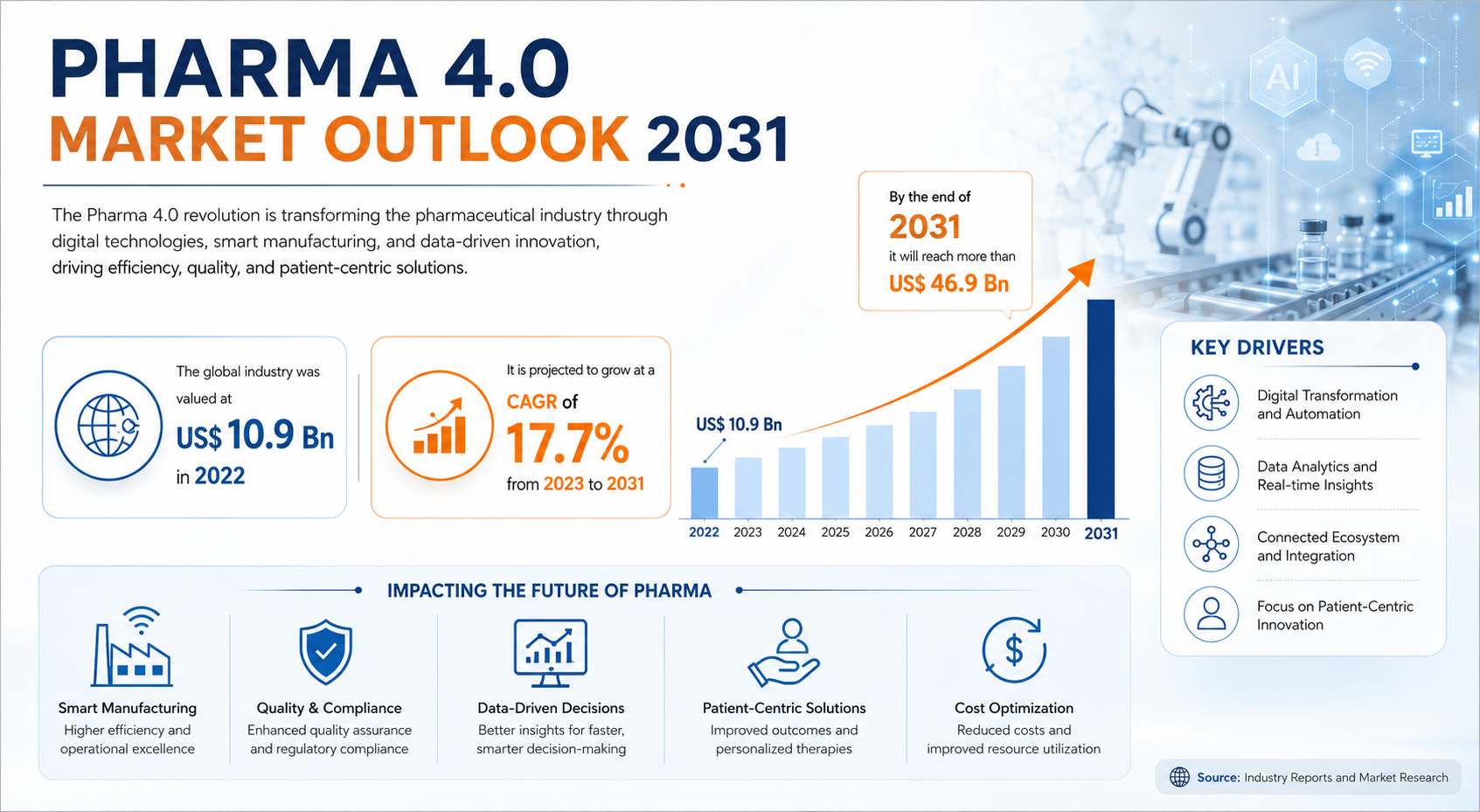
The global Pharma 4.0 Market is witnessing remarkable expansion as pharmaceutical companies increasingly integrate advanced digital technologies into drug discovery, manufacturing, clinical trials, and supply chain operations. According to the latest industry analysis, the global pharma 4.0 market was valued at US$ 10.9 Billion in 2022 and is projected to surpass US$ 46.9 Billion by the end of 2031, expanding at a robust CAGR of 17.7% during the forecast period from 2023 to 2031.
The market is being driven by growing demand for personalized medicine, rising regulatory pressure to improve drug quality and patient safety, and increasing adoption of artificial intelligence (AI), cloud computing, big data analytics, and Internet of Things (IoT) technologies across pharmaceutical operations. Pharmaceutical manufacturers are increasingly embracing digital transformation strategies to improve operational efficiency, accelerate drug development timelines, reduce manufacturing costs, and enhance product quality.
The rapid evolution of smart manufacturing systems and connected pharmaceutical production tools is further reshaping the pharmaceutical industry landscape. Industry experts anticipate that the integration of advanced automation technologies, digital twins, predictive analytics, and AI-driven process optimization systems will continue to fuel strong market growth throughout the forecast period.
Market Size and Overview
Pharma 4.0 refers to the integration of Industry 4.0 technologies into pharmaceutical manufacturing, drug discovery, and healthcare operations. The concept focuses on creating smart, connected, and data-driven pharmaceutical ecosystems that improve productivity, regulatory compliance, operational efficiency, and patient outcomes.
The pharmaceutical industry is undergoing a major digital transformation as companies adopt technologies such as artificial intelligence, machine learning, cloud computing, cyber-physical systems, IoT-enabled devices, and advanced robotics. These technologies enable real-time monitoring, process automation, remote sensing, predictive maintenance, digital simulation, and end-to-end traceability across pharmaceutical manufacturing networks.
The market has gained significant momentum due to increasing pressure on pharmaceutical companies to bring drugs to market faster while maintaining strict quality and safety standards. The adoption of pharma 4.0 technologies helps manufacturers optimize supply chain management, reduce production errors, minimize downtime, and accelerate clinical trial processes.
North America is expected to account for a significant share of the global market owing to its advanced healthcare infrastructure, strong pharmaceutical industry presence, and high adoption of digital technologies. Government initiatives supporting healthcare digitalization and smart manufacturing are also contributing to regional growth.
Among technologies, artificial intelligence, cloud computing, big data analytics, and IoT solutions are experiencing rapid adoption as pharmaceutical companies prioritize digital transformation initiatives and data-driven decision-making.
Key Market Growth Drivers
Increasing Demand for Personalized Medicine
The growing focus on personalized medicine and targeted therapies is one of the primary factors driving the growth of the pharma 4.0 market. Pharmaceutical companies are increasingly leveraging AI and big data analytics to analyze genomic data, patient records, and clinical trial information to develop highly targeted treatments.
Advanced digital technologies enable pharmaceutical manufacturers to create customized therapies based on individual patient profiles, improving treatment effectiveness and patient outcomes. Personalized medicine also reduces adverse drug reactions and supports precision healthcare initiatives.
Rising Adoption of Artificial Intelligence and Machine Learning
Artificial intelligence and machine learning technologies are transforming drug discovery and development processes. AI-powered systems can analyze massive datasets to identify potential drug candidates, predict molecular behavior, optimize clinical trial designs, and accelerate research timelines.
Machine learning algorithms also improve predictive analytics capabilities, enabling pharmaceutical companies to identify potential manufacturing defects, supply chain disruptions, and equipment maintenance needs before problems occur.
The increasing use of AI in pharmaceutical operations is significantly reducing research and development costs while accelerating time-to-market for new therapies.
Growth in Smart Manufacturing and Automation
Pharmaceutical manufacturers are under constant pressure to improve operational efficiency, reduce production costs, and comply with stringent regulatory standards. As a result, companies are increasingly adopting smart manufacturing systems and advanced automation technologies.
Connected devices and IoT sensors enable real-time monitoring of production processes, equipment performance, and environmental conditions across manufacturing facilities. This improves product consistency, reduces waste, and enhances quality assurance.
Automation technologies and robotics also help reduce dependence on manual labor while improving manufacturing precision, productivity, and scalability.
Expansion of Cloud Computing Solutions
Cloud computing has become a critical component of pharma 4.0 implementation. Cloud-based platforms enable pharmaceutical companies to securely store, process, and analyze large volumes of data without investing heavily in on-premise infrastructure.
Cloud solutions facilitate remote collaboration across departments, research centers, and manufacturing sites while enhancing scalability and operational flexibility. Pharmaceutical companies are increasingly adopting cloud-based solutions to improve data accessibility, streamline workflows, and accelerate innovation.
The growing demand for remote access, real-time analytics, and digital collaboration tools is expected to drive continued cloud computing adoption across the pharmaceutical sector.
Increasing Regulatory Pressure
Regulatory agencies worldwide are imposing stricter requirements related to product quality, safety, traceability, and compliance. Pharma 4.0 technologies provide real-time monitoring and end-to-end visibility across manufacturing and supply chain operations, helping companies meet regulatory expectations more efficiently.
Digital tracking systems, predictive analytics, and automated quality control processes are enabling pharmaceutical companies to enhance compliance while minimizing operational risks.
Analysis of Key Players – Key Player Strategies
The global pharma 4.0 market is fragmented, with several technology providers, cloud service companies, industrial automation firms, and healthcare technology companies competing for market share.
Leading companies operating in the global market include:
- Siemens Healthcare GmbH
- GE Healthcare
- IBM Corporation
- Amazon Web Services, Inc.
- Microsoft Corporation
- Oracle Corporation
- ABB
- Honeywell International Inc.
- Cisco Systems, Inc.
Strategic Collaborations and Partnerships
Major market participants are actively forming strategic partnerships with pharmaceutical companies, biotechnology firms, and healthcare providers to strengthen their digital healthcare capabilities.
Collaborations between technology companies and pharmaceutical manufacturers are accelerating the development of AI-driven drug discovery platforms, cloud-based analytics systems, and smart manufacturing solutions.
Expansion of Cloud and AI Offerings
Companies such as Microsoft, Amazon Web Services, and IBM are heavily investing in cloud computing infrastructure and AI-based healthcare solutions to support pharmaceutical digital transformation initiatives.
Advanced AI and machine learning capabilities are helping pharmaceutical companies improve drug discovery efficiency, optimize manufacturing operations, and enhance clinical trial management.
Focus on Automation and Smart Manufacturing
Industrial automation leaders including ABB, Siemens, Honeywell, and Cisco are expanding their smart manufacturing portfolios to support pharmaceutical production automation and digital factory implementation.
These companies are offering connected manufacturing platforms, IoT-enabled systems, robotics solutions, and predictive maintenance technologies to improve pharmaceutical production efficiency and compliance.
Mergers and Acquisitions
Leading players are also pursuing mergers and acquisitions to strengthen their technological capabilities and expand their customer base. Acquisitions of healthcare AI companies, cloud technology firms, and digital analytics providers are becoming increasingly common in the pharma 4.0 landscape.
Market Challenges & Opportunities
Challenges
Despite strong growth prospects, the pharma 4.0 market faces several operational and regulatory challenges.
One major challenge is the complexity of the regulatory environment in the pharmaceutical industry. Companies must comply with strict quality standards, data privacy regulations, and manufacturing guidelines while implementing advanced digital technologies.
Resistance to technological change and lack of skilled professionals capable of managing advanced digital systems also pose challenges for market growth.
Additionally, high implementation costs associated with AI systems, cloud infrastructure, smart manufacturing equipment, and cybersecurity solutions may limit adoption among small and medium-sized pharmaceutical companies.
Limited access to advanced healthcare infrastructure and digital technologies in developing countries could further restrain market expansion.
Opportunities
The market presents significant opportunities driven by ongoing healthcare digitalization and increasing investment in pharmaceutical innovation.
The growing adoption of AI-driven drug discovery platforms and predictive analytics solutions offers substantial growth potential. Pharmaceutical companies are increasingly recognizing the value of digital twins, real-time analytics, and automation systems in improving operational performance.
Emerging markets across Asia Pacific, Latin America, and the Middle East are expected to provide lucrative opportunities as healthcare infrastructure improves and digital transformation initiatives accelerate.
The increasing demand for remote monitoring, telehealth integration, and cloud-based pharmaceutical operations is also expected to create new revenue opportunities for technology providers.
Key Player Strategies
Leading market participants are implementing several strategic initiatives to strengthen their competitive positions:
- Investment in AI-powered pharmaceutical platforms
- Expansion of cloud computing and analytics services
- Strategic partnerships with pharmaceutical manufacturers
- Development of smart manufacturing and IoT-enabled systems
- Acquisitions of healthcare technology companies
- Focus on automation and predictive maintenance solutions
- Enhancement of cybersecurity and data protection capabilities
- Geographic expansion into emerging healthcare markets
These strategies are expected to support long-term market growth and improve digital transformation capabilities across the pharmaceutical industry.
Recent Developments
In March 2022, Microsoft Corporation announced the acquisition of Nuance Communications to expand its capabilities in the healthcare sector. The acquisition is aimed at enhancing Microsoft’s AI and cloud offerings for healthcare providers and accelerating the delivery of new solutions for clinical documentation, patient engagement, and other healthcare scenarios.
In 2021, Amazon Web Services, Inc. announced a partnership with Novartis, a Switzerland-based pharmaceutical company, to develop and deploy AI and machine learning solutions for drug discovery and development.
In 2020, Amazon Web Services, Inc. announced a partnership with Moderna, a biotechnology company that develops mRNA-based vaccines and therapeutics, to support the development and manufacture of the former’s COVID-19 vaccine. Amazon Web Services, Inc. provided cloud computing, storage, and analytics services to help Moderna accelerate the development process.
Investment Landscape and ROI Outlook
The pharma 4.0 market is emerging as a highly attractive investment sector due to rapid digital transformation across the pharmaceutical industry and growing demand for intelligent manufacturing solutions.
Investments in artificial intelligence, cloud infrastructure, IoT-enabled manufacturing systems, and big data analytics platforms are expected to generate substantial long-term returns. Technology companies and venture capital firms are increasingly investing in healthcare automation, digital therapeutics, and pharmaceutical analytics startups.
North America currently represents the largest investment market due to its advanced pharmaceutical ecosystem and strong technology adoption rates. However, Asia Pacific is expected to emerge as a high-growth investment destination owing to increasing pharmaceutical manufacturing activities and rising healthcare digitalization initiatives.
The integration of AI-driven drug discovery, predictive analytics, and smart manufacturing technologies is expected to significantly improve operational efficiency and reduce production costs, thereby delivering strong ROI for pharmaceutical companies.
Companies focusing on cloud-based pharmaceutical operations, digital twins, robotics automation, and AI-powered clinical trial management are expected to achieve substantial revenue growth over the forecast period.
Market Segmentations
By Technology
- Artificial Intelligence (AI)
- Big Data Analytics
- Cloud Computing
- Internet of Things (IoT)
- Others
By Application
- Drug Discovery and Development
- Clinical Trials
- Manufacturing
- Others
By End-user
- Pharmaceutical Companies
- Biotechnology Companies
- CROs and CMOs
- Others
By Region
- North America
- Latin America
- Europe
- Asia Pacific
- Middle East & Africa
Countries Covered
- U.S.
- Canada
- Germany
- U.K.
- France
- Italy
- Spain
- China
- India
- Japan
- Australia & New Zealand
- Brazil
- Mexico
- South Africa
- GCC Countries
Why Buy This Report?
- Gain comprehensive insights into the global pharma 4.0 market and future growth prospects
- Understand major market drivers, restraints, opportunities, and technology trends
- Analyze the competitive landscape and key player strategies
- Evaluate emerging opportunities in AI, IoT, cloud computing, and smart manufacturing
- Access detailed market forecasts, segmentation analysis, and regional outlooks
- Identify high-growth investment markets and digital healthcare opportunities
- Monitor recent industry developments, partnerships, and acquisitions
- Benchmark competitors and assess long-term market potential
Frequently Asked Questions (FAQs)
1. What is the projected size of the global pharma 4.0 market by 2031?
The global pharma 4.0 market is projected to surpass US$ 46.9 Billion by 2031.
2. What is driving the growth of the pharma 4.0 market?
Major growth drivers include increasing demand for personalized medicine, rising adoption of AI and cloud computing, growth in smart manufacturing, and increasing regulatory pressure for product quality and safety.
3. Which technologies are widely used in pharma 4.0?
Key technologies include Artificial Intelligence (AI), Big Data Analytics, Cloud Computing, Internet of Things (IoT), robotics, and predictive analytics systems.
4. Which region dominates the pharma 4.0 market?
North America is expected to hold a significant market share due to strong healthcare infrastructure, high technology adoption, and substantial pharmaceutical R&D investments.
5. Who are the leading players in the pharma 4.0 market?
Leading companies include Siemens Healthcare GmbH, GE Healthcare, IBM Corporation, Amazon Web Services, Inc., Microsoft Corporation, Oracle Corporation, ABB, Honeywell International Inc., and Cisco Systems, Inc.





Leave a Reply