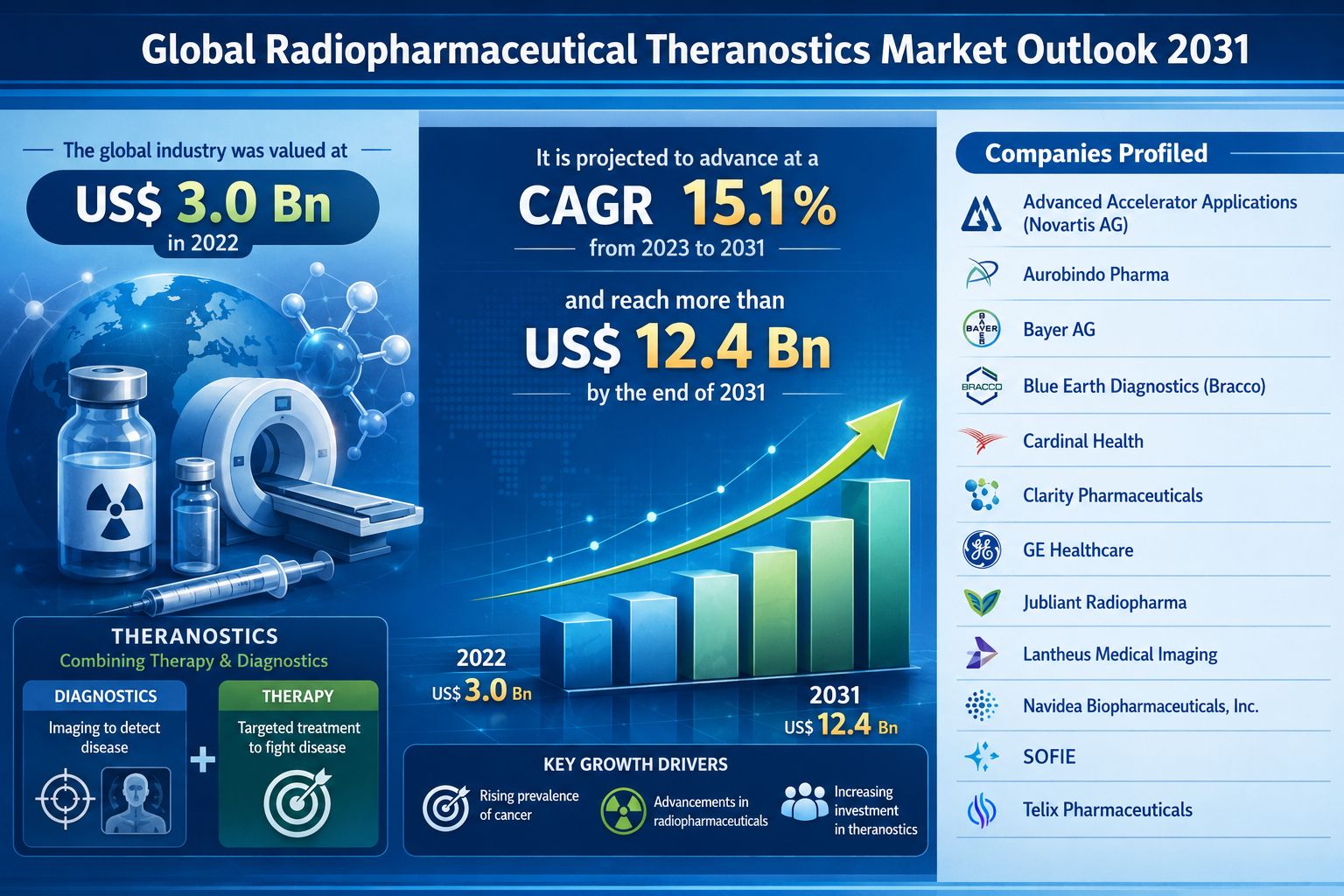
The global radiopharmaceutical theranostics market was valued at US$ 3.0 Bn in 2022 and is projected to surpass US$ 12.4 Bn by the end of 2031, expanding at a robust CAGR of 15.1% from 2023 to 2031. The market is witnessing rapid transformation due to increasing adoption of precision medicine, growing prevalence of cancer, technological advancements in molecular imaging, and rising investments in targeted radionuclide therapy.
Radiopharmaceutical theranostics has emerged as one of the most promising fields in oncology and nuclear medicine, offering combined diagnostic and therapeutic capabilities using radioactive isotopes. The increasing integration of PET-CT and SPECT-CT imaging technologies with targeted therapeutic agents is significantly improving treatment accuracy and patient outcomes.
→Discover Market Opportunities – Request Your Sample Copy Now: https://www.transparencymarketresearch.com/sample/sample.php?flag=S&rep_id=82604
Market Size
The global radiopharmaceutical theranostics market generated US$ 3.0 Bn in revenue in 2022. With expanding clinical applications and increasing investment in oncology-focused nuclear medicine, the market is expected to exceed US$ 12.4 Bn by 2031.
The projected growth trajectory reflects strong demand for targeted cancer therapies that minimize toxicity while maximizing therapeutic efficacy. Increasing healthcare spending, favorable reimbursement scenarios in developed economies, and rising awareness regarding personalized treatment are expected to sustain long-term market growth.
Market Overview
Radiopharmaceutical theranostics combines diagnostic imaging and targeted therapy into a single clinical approach. The same radiopharmaceutical agent is used both to identify diseased tissue and to deliver therapeutic radiation directly to affected cells.
This innovative treatment strategy has become increasingly important in oncology, particularly for neuroendocrine tumors, metastatic prostate cancer, and lymphoma. Unlike conventional chemotherapy or external radiation therapy, theranostic agents deliver highly targeted treatment while minimizing damage to surrounding healthy tissues.
The market has evolved rapidly with the development of advanced isotopes such as Lutetium-177, Gallium-68, Yttrium-90, and Radium-223. These isotopes are increasingly utilized in combination with biomarkers and targeting molecules for precision therapy applications.
The integration of molecular imaging with therapeutic radiopharmaceuticals has improved disease detection, treatment planning, and monitoring. As healthcare systems increasingly prioritize precision medicine, radiopharmaceutical theranostics is expected to become a mainstream treatment option in oncology care pathways.
Analysts’ Viewpoint
Industry analysts believe the radiopharmaceutical theranostics market is entering a high-growth phase driven by increasing cancer incidence and advancements in targeted nuclear medicine technologies. Growing demand for personalized medicine and non-invasive treatment methods is creating favorable conditions for market expansion.
The rise in adoption of PET-CT and SPECT-CT imaging technologies is improving diagnostic precision and accelerating theranostic adoption globally. Additionally, pharmaceutical companies are increasing research and development investments to introduce novel theranostic agents targeting specific biomarkers associated with cancer progression.
The market is also benefiting from government funding initiatives, strategic collaborations between pharmaceutical companies and research institutes, and rapid expansion of nuclear medicine infrastructure worldwide.
Key Market Growth Drivers
Rising Global Cancer Burden
The growing prevalence of cancer remains the primary driver of the radiopharmaceutical theranostics market. According to global health statistics, cancer continues to be one of the leading causes of mortality worldwide.
The American Cancer Society estimated approximately 1.9 million new cancer cases and 608,570 cancer-related deaths in the U.S. during 2021. Furthermore, the National Cancer Institute projected the number of people living with cancer in the U.S. to reach 22.2 million by 2030.
The increasing incidence of prostate cancer, neuroendocrine tumors, and metastatic cancers is fueling demand for targeted radionuclide therapies such as Lutetium-177-based treatments.
Growing Demand for Personalized Medicine
Healthcare providers are increasingly shifting toward personalized treatment approaches tailored to individual patient profiles and disease biomarkers. Radiopharmaceutical theranostics enables highly targeted therapy while minimizing adverse effects, making it ideal for precision oncology applications.
Personalized medicine is improving treatment efficacy and patient outcomes, particularly in complex and advanced-stage cancers where conventional therapies have limited success.
Technological Advancements in Molecular Imaging
Rapid advancements in PET imaging, SPECT imaging, and hybrid diagnostic systems are accelerating market growth. High-resolution imaging technologies allow physicians to identify tumors with greater precision and monitor therapeutic responses more effectively.
The growing availability of cyclotron-produced isotopes and automated radiopharmaceutical production systems is further supporting market expansion.
Surge in Investment in Novel Theranostic Agents
Investment in research and development activities has increased significantly over the past few years. Government agencies, pharmaceutical companies, and private investors are funding the development of innovative theranostic compounds targeting specific cancer biomarkers.
New product pipelines focused on prostate cancer, neuroendocrine tumors, and targeted alpha therapies are expected to create substantial growth opportunities during the forecast period.
Market Challenges & Opportunities
Challenges
Despite strong growth potential, the radiopharmaceutical theranostics market faces several operational and regulatory challenges.
One of the major barriers is the high cost associated with radiopharmaceutical production, transportation, and storage. Many isotopes have short half-lives, requiring advanced logistics infrastructure and rapid delivery systems.
Regulatory complexities related to radioactive materials and nuclear medicine procedures can delay product approvals and commercialization. Additionally, limited availability of specialized healthcare professionals trained in nuclear medicine remains a challenge in emerging markets.
Supply chain constraints related to isotope production and shortages of nuclear reactor capacity may also impact market growth.
Opportunities
The market presents significant opportunities for innovation and expansion.
The development of targeted alpha therapies is expected to revolutionize cancer treatment by delivering highly potent radiation directly to tumor cells with minimal collateral damage.
Emerging economies are also creating new growth avenues due to increasing healthcare investments and rising adoption of advanced cancer therapies.
Expansion of theranostic applications beyond oncology into cardiology and neurological disorders could further broaden the market landscape over the coming years.
→Explore Strategies & Trends – Request Full Report Access – https://www.transparencymarketresearch.com/sample/sample.php?flag=S&rep_id=82604
Market Segmentation
By Radioisotope
The Lutetium-177 segment dominated the global market in 2022 and is expected to maintain its leadership position during the forecast period. Lu-177 has demonstrated high efficacy and relatively low toxicity in targeted radionuclide therapy applications.
Other important radioisotopes include:
- Technetium-99
- Gallium-68
- Iodine-131
- Radium-223
- Fluorine-18
- Yttrium-90
- Copper-67 & 64
- Samarium-153
By Application
The oncology segment accounted for the largest market share in 2022 due to increasing use of theranostics in cancer diagnosis and targeted therapy.
Other applications include:
- Cardiology
- Neurology and other disease applications
By Source
Cyclotrons dominated the market owing to rising production of PET imaging isotopes such as F-18, C-11, and N-13. Increasing demand for PET imaging in oncology is expected to sustain segment growth.
By Approach
The targeted therapeutic (Rx) segment led the market due to growing adoption of personalized cancer therapies and targeted radionuclide treatment approaches.
By Radiotracer Type
The peptidic segment held the largest market share due to increasing use of peptide-based agents such as DOTATATE, DOTATOC, DOTANOC, and PSMA-617.
By End-user
Hospitals represented the dominant end-user segment due to increasing use of nuclear medicine procedures and rising patient demand for advanced cancer therapies.
Academic and research institutes are also expanding their participation in clinical trials and theranostic innovation programs.
Regional Outlook
United States
The U.S. accounted for the largest share of the global radiopharmaceutical theranostics market in 2022. The country benefits from advanced healthcare infrastructure, high healthcare spending, favorable regulatory policies, and strong presence of leading industry players.
Growing demand for targeted oncology therapies and rapid adoption of nuclear medicine technologies are driving market growth in the region.
Europe
The EU market is witnessing significant expansion due to increasing use of radiopharmaceuticals in nuclear medicine and growing prevalence of cancer.
Countries such as Germany, the U.K., France, Italy, and Spain are investing heavily in molecular imaging technologies and clinical research programs focused on theranostics.
Rest of the World
Emerging markets are expected to witness substantial growth due to improving healthcare infrastructure, rising awareness about precision medicine, and increasing investments in cancer treatment technologies.
Analysis of Key Players – Key Player Strategies
Leading companies operating in the global radiopharmaceutical theranostics market are focusing on mergers & acquisitions, strategic collaborations, clinical trial expansion, and new product launches to strengthen their market positions.
Major players include:
- Advanced Accelerator Applications (Novartis AG)
- Aurobindo Pharma
- Bayer AG
- Blue Earth Diagnostics (Bracco)
- Cardinal Health
- Clarity Pharmaceuticals
- GE Healthcare
- Jubliant Radiopharma
- Lantheus Medical Imaging
- Navidea Biopharmaceuticals, Inc.
- SOFIE
- Telix Pharmaceuticals
Key Player Strategies
Key market participants are increasingly investing in:
- Development of novel theranostic agents
- Expansion of isotope production capabilities
- Strategic partnerships with healthcare providers
- Clinical trial programs targeting advanced cancers
- Geographic expansion across emerging markets
- Personalized medicine research initiatives
Companies are also emphasizing targeted alpha therapy development and companion diagnostics to improve treatment precision and therapeutic outcomes.
Recent Developments
On March 23, 2022, Novartis announced the U.S. Food and Drug Administration (FDA) approval for Pluvicto (lutetium Lu 177 vipivotide tetraxetan) for the treatment of adult patients with prostate-specific membrane antigen-positive metastatic castration-resistant prostate cancer (PSMA-positive mCRPC).
In June 2022, Blue Earth Diagnostics announced completion of patient accrual in its phase 3 REVELATE clinical trial of 18F-fluciclovine for detecting recurrent brain metastases after radiotherapy.
On October 18, 2021, Novartis announced positive results from the phase III NETTER-1 trial evaluating Lutathera in patients with advanced gastroenteropancreatic neuroendocrine tumors (GEP-NETs). The study demonstrated significant improvement in progression-free survival compared to standard care.
Investment Landscape and ROI Outlook
The radiopharmaceutical theranostics market is attracting strong investor interest due to its high-growth potential and expanding clinical applications.
Investment activity is increasing across:
- Radiopharmaceutical manufacturing facilities
- Cyclotron infrastructure
- Nuclear medicine imaging technologies
- Precision oncology research
- Clinical trial development
The market offers attractive long-term ROI opportunities due to rising cancer prevalence, increasing adoption of personalized medicine, and growing regulatory support for innovative oncology therapies.
Companies with strong isotope production capabilities and advanced theranostic pipelines are expected to generate substantial revenue growth over the next decade.
Why Buy This Report?
This report provides comprehensive insights into the global radiopharmaceutical theranostics market, including:
- Detailed market size and forecast analysis through 2031
- In-depth segmentation analysis across radioisotopes, applications, approaches, and end-users
- Competitive landscape and strategic profiling of leading companies
- Analysis of market drivers, restraints, opportunities, and emerging trends
- Regional outlook covering the U.S., EU, and Rest of the World
- Investment analysis and future growth opportunities
- Recent developments and regulatory updates shaping the industry
The report is designed to help investors, healthcare providers, pharmaceutical companies, and research organizations make informed strategic decisions.
FAQs
- How big was the global radiopharmaceutical theranostics market in 2022?
The global radiopharmaceutical theranostics market was valued at US$ 3.0 Bn in 2022.
- What is the projected market size by 2031?
The market is expected to exceed US$ 12.4 Bn by the end of 2031.
- What is the expected CAGR during the forecast period?
The market is projected to expand at a CAGR of 15.1% from 2023 to 2031.
- Which radioisotope segment dominated the market in 2022?
The Lutetium-177 segment accounted for the leading market share due to its high efficacy and low toxicity.
- Which region is expected to dominate the market during the forecast period?
The United States is expected to maintain a dominant position owing to advanced healthcare infrastructure, favorable regulatory policies, and strong investment in nuclear medicine technologies.
Buy Full Report Now: https://www.transparencymarketresearch.com/checkout.php?rep_id=82604<ype=S
→Explore Latest Research Reports by Transparency Market Research:
Taurine Market: https://www.transparencymarketresearch.com/taurine-market.html
Amlodipine Market: https://www.transparencymarketresearch.com/amlodipine-market.html
Organ Preservation Solutions Market: https://www.transparencymarketresearch.com/organ-preservation-solutions.html
About Transparency Market Research
Transparency Market Research, a global market research company registered at Wilmington, Delaware, United States, provides custom research and consulting services. Our exclusive blend of quantitative forecasting and trends analysis provides forward-looking insights for thousands of decision makers. Our experienced team of Analysts, Researchers, and Consultants use proprietary data sources and various tools & techniques to gather and analyses information.
Our data repository is continuously updated and revised by a team of research experts, so that it always reflects the latest trends and information. With a broad research and analysis capability, Transparency Market Research employs rigorous primary and secondary research techniques in developing distinctive data sets and research material for business reports.




Leave a Reply