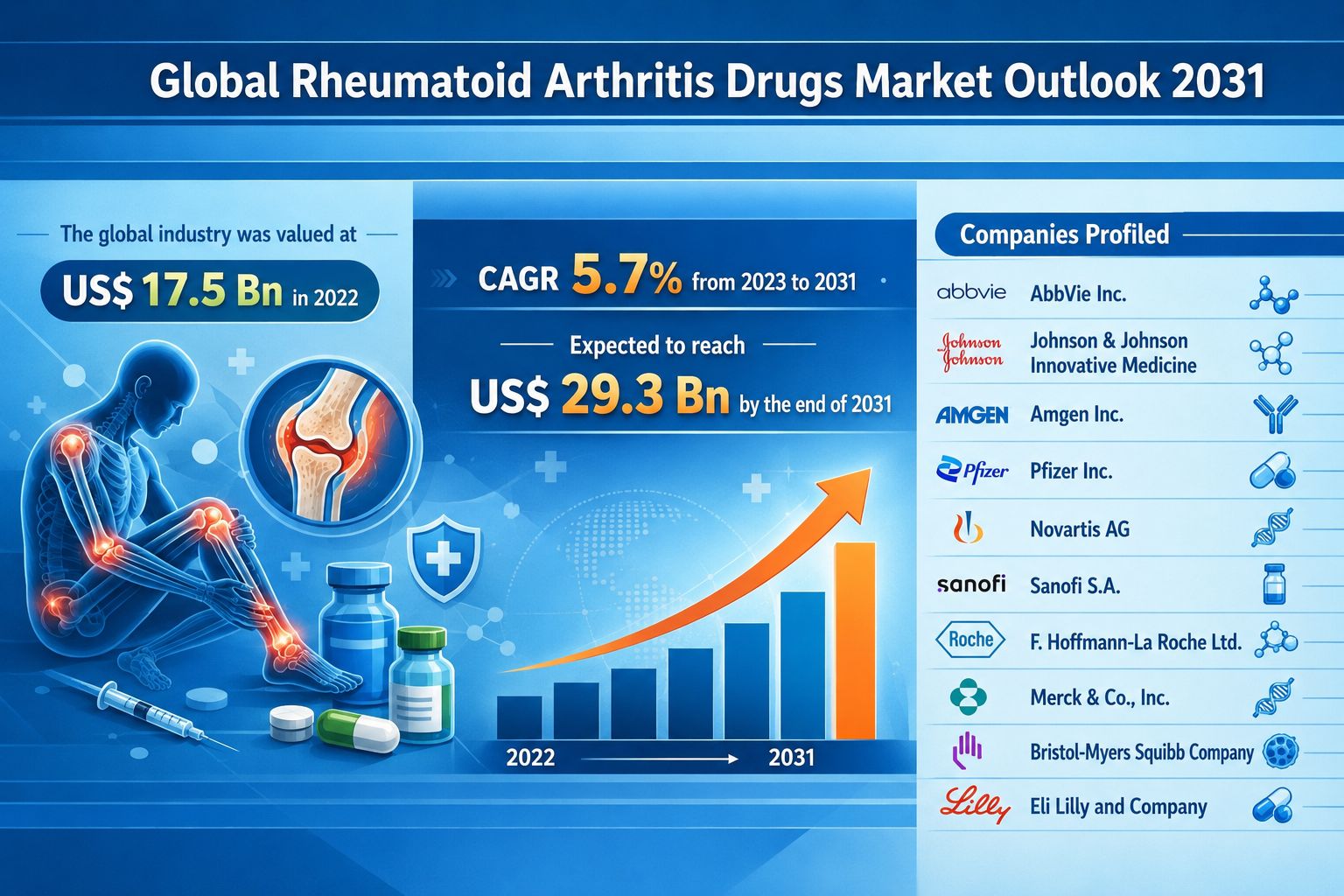
The global Rheumatoid Arthritis drugs market was valued at US$ 17.5 Bn in 2022 and is projected to expand at a compound annual growth rate (CAGR) of 5.7% from 2023 to 2031, reaching approximately US$ 29.3 Bn by the end of 2031. The market expansion is being fueled by the increasing prevalence of autoimmune disorders, growing aging population, wider adoption of biologic therapies, and rising awareness regarding early diagnosis and treatment.
The steady growth trajectory of the market also reflects the increasing investments by pharmaceutical companies in advanced biologics, biosimilars, and disease-modifying anti-rheumatic drugs (DMARDs). Healthcare providers are increasingly emphasizing long-term disease management, thereby boosting prescription volumes globally.
→Discover Market Opportunities – Request Your Sample Copy Now: https://www.transparencymarketresearch.com/sample/sample.php?flag=S&rep_id=2011
Market Overview
Rheumatoid arthritis (RA) is a chronic autoimmune disease that primarily affects joints including the hands, wrists, knees, and ankles. In severe cases, it also impacts major organs such as the heart and lungs. Symptoms such as swelling, pain, stiffness, redness, and inflammation significantly reduce patient mobility and quality of life.
According to the World Health Organization (WHO), nearly 18 million people worldwide suffered from rheumatoid arthritis in 2019, while approximately 13 million patients experienced severe forms of the disease. Furthermore, a study published in Rheumatology International estimated the global prevalence of rheumatoid arthritis at nearly 0.9%.
The growing burden of rheumatoid arthritis has increased the demand for effective therapeutic solutions such as NSAIDs, corticosteroids, biologics, and DMARDs. Continuous innovations in targeted therapies and monoclonal antibodies are reshaping the treatment landscape and improving patient outcomes.
The market is also benefiting from healthcare reforms, awareness campaigns by health organizations, and increasing access to specialized rheumatology care across emerging economies.
Key Market Growth Drivers
Increase in Incidence of Rheumatoid Arthritis
The rising prevalence of rheumatoid arthritis remains one of the strongest factors supporting market expansion. Sedentary lifestyles, obesity, smoking habits, genetic predisposition, and environmental factors are contributing to higher disease incidence globally.
Healthcare organizations such as the WHO are actively promoting early diagnosis and rehabilitation through initiatives like Rehabilitation 2030, which encourages governments and healthcare institutions to improve patient access to treatment and rehabilitation services.
As the patient population rises, demand for long-term medications and biologic therapies is expected to increase substantially throughout the forecast period.
Growing Demand for Over-the-Counter (OTC) Medications
The growing preference for over-the-counter pain management drugs is significantly driving market demand. NSAIDs such as ibuprofen, naproxen, aspirin, acetylsalicylate, and etodolac continue to be widely used as first-line treatments for pain and inflammation management.
Organizations including the American College of Rheumatology (ACR), Arthritis Foundation (AF), and American Academy of Orthopedic Surgeons (AAOS) recommend NSAIDs for arthritis-related pain management.
Elderly patients increasingly prefer OTC medications to avoid invasive surgeries and post-operative complications. This trend is expected to remain a major growth catalyst, especially in developing economies with rising self-medication practices.
Expansion of Geriatric Population
The aging global population is creating strong growth opportunities for rheumatoid arthritis drug manufacturers. Older adults are more susceptible to autoimmune disorders and chronic inflammatory diseases.
According to the Asian Development Bank, by 2050 nearly one in four people in Asia Pacific will be over 60 years old, while the elderly population in the region is expected to reach 1.3 billion. Such demographic shifts are expected to significantly increase treatment demand across Asia Pacific.
Technological Advancements in Biologics and Precision Medicine
Biologic response modifiers and targeted therapies are transforming rheumatoid arthritis treatment. Pharmaceutical companies are investing heavily in monoclonal antibodies, biosimilars, and precision medicine to improve therapeutic efficacy and reduce side effects.
The increasing adoption of biosimilars is also helping lower treatment costs and improve accessibility, particularly in Europe and emerging economies.
Analysis of Key Players – Key Player Strategies
The global rheumatoid arthritis drugs market is highly competitive and characterized by extensive research and development activities, strategic collaborations, acquisitions, and product launches.
Major companies operating in the market include:
- AbbVie Inc.
- Johnson & Johnson Innovative Medicine
- Amgen Inc.
- Pfizer Inc.
- Novartis AG
- Sanofi S.A.
- F. Hoffmann-La Roche Ltd.
- Merck & Co., Inc.
- Bristol-Myers Squibb Company
- Eli Lilly and Company
These players are focusing on:
- Expansion of biologic and biosimilar product portfolios
- Strategic licensing and commercialization agreements
- Investments in precision medicine and monoclonal antibodies
- Geographic expansion into emerging healthcare markets
- Partnerships with research institutions and biotechnology firms
- Development of next-generation DMARDs and immunotherapies
Several companies are also emphasizing cost-effective biosimilars to capture price-sensitive markets and improve patient accessibility.
→Explore Strategies & Trends – Request Full Report Access – https://www.transparencymarketresearch.com/sample/sample.php?flag=S&rep_id=2011
Market Challenges & Opportunities
Challenges
Despite positive growth prospects, the rheumatoid arthritis drugs market faces several challenges:
- High costs associated with biologic therapies
- Side effects linked to long-term corticosteroid and NSAID usage
- Limited healthcare access in low-income regions
- Stringent regulatory approval processes
- Patent expiration and pricing pressure on branded drugs
- Risk of adverse immune responses from biologic therapies
The affordability of advanced biologic drugs remains a major concern, particularly in developing countries where reimbursement infrastructure is limited.
Opportunities
The market also presents strong growth opportunities:
- Rising adoption of biosimilars
- Growing investments in personalized medicine
- Increasing telemedicine and digital healthcare adoption
- Expansion of online pharmacies
- Untapped emerging markets in Asia, Latin America, and Africa
- Development of targeted biologics with improved safety profiles
Pharmaceutical firms that focus on affordable treatment solutions and strategic regional partnerships are likely to gain significant competitive advantages over the coming years.
Key Player Strategies
Leading companies are implementing several growth strategies to strengthen their market presence:
- Accelerating clinical trials for advanced biologic therapies
- Launching interchangeable biosimilars
- Expanding manufacturing capabilities
- Investing in AI-driven drug discovery platforms
- Strengthening distribution networks through hospital and retail pharmacies
- Increasing patient assistance and awareness programs
The growing emphasis on biosimilars is particularly important as healthcare systems globally seek to reduce treatment costs without compromising therapeutic effectiveness.
Recent Developments
- In July 2023, Biocon Biologics Ltd., a subsidiary of Biocon Ltd, announced the availability of HULIO (adalimumab-fkjp) injection, a biosimilar to Humira (adalimumab), in the U.S. for the treatment of rheumatoid arthritis
- In February 2022, Pfizer Inc. announced that the U.S. Food and Drug Administration (FDA) accepted for review the Prior Approval Supplement (PAS) to the Biologics License Application (BLA) for ABRILADA (adalimumab-afzb) as an interchangeable biosimilar to Humira (adalimumab)
- In February 2022, Biogen Inc. and Xbrane Biopharma AB entered into a commercialization and license agreement to develop, manufacture, and commercialize Xcimzane, a preclinical monoclonal antibody that is a proposed biosimilar referencing CIMZIA (certolizumab pegol)
Investment Landscape and ROI Outlook
The rheumatoid arthritis drugs market continues to attract substantial investments due to the growing patient population and increasing biologic adoption.
Investors are particularly focusing on:
- Biosimilar development
- Monoclonal antibody research
- Precision medicine platforms
- Digital healthcare integration
- AI-assisted drug development
- Expansion into emerging pharmaceutical markets
The long-term ROI outlook remains highly favorable due to recurring treatment demand, chronic disease prevalence, and expanding healthcare expenditures globally. Companies that successfully commercialize affordable biologics and innovative immunotherapies are expected to generate strong revenue growth through 2031.
Market Segmentations
By Drug Type
- Nonsteroidal Anti-inflammatory Drugs (NSAIDs)
- Corticosteroids
- Disease Modifying Anti-rheumatic Drugs (DMARDs)
- Biologic Response Modifiers (Biologics)
Among these, biologics and DMARDs are expected to witness the fastest growth due to increasing therapeutic effectiveness and targeted treatment capabilities.
By Distribution Channel
- Hospital Pharmacy
- Retail Pharmacy
- Online Pharmacy
Hospital pharmacies held the largest market share in 2022 owing to higher prescription volumes and specialist treatment administration.
By Region
North America
North America remains a significant market due to high rheumatoid arthritis prevalence, strong healthcare infrastructure, and rapid adoption of monoclonal antibodies and biologics. According to the CDC, more than 58 million people in the U.S. suffer from arthritis.
Europe
Europe is witnessing strong growth driven by the increasing adoption of biosimilars. Surveys indicate that nearly 92% of EU clinicians prescribed biosimilars for rheumatoid arthritis treatment in 2020.
Asia Pacific
Asia Pacific is expected to dominate the market during the forecast period due to rising geriatric population, improving healthcare infrastructure, and increasing awareness regarding autoimmune diseases.
Latin America
Improving healthcare access and increasing pharmaceutical investments are supporting market expansion in Brazil and Mexico.
Middle East & Africa
The market in the Middle East & Africa is gradually growing due to improving healthcare spending and rising awareness regarding chronic inflammatory diseases.
Why Buy This Report?
- Gain detailed insights into market size, forecast, and growth trends through 2031
- Understand major market drivers, challenges, and opportunities
- Analyze competitive strategies of leading pharmaceutical companies
- Evaluate regional growth potential and investment opportunities
- Access comprehensive segmentation analysis by drug type and distribution channel
- Identify emerging trends in biosimilars, biologics, and precision medicine
- Understand the impact of aging population and chronic disease prevalence on future demand
- Obtain strategic intelligence for investment, expansion, and partnership decisions
FAQs
How big was the rheumatoid arthritis drugs market in 2022?
The global rheumatoid arthritis drugs market was valued at US$ 17.5 Bn in 2022.
What is the projected market value by 2031?
The market is expected to reach approximately US$ 29.3 Bn by the end of 2031.
What is driving the growth of the rheumatoid arthritis drugs market?
Key growth drivers include increasing rheumatoid arthritis prevalence, rising demand for OTC medications, growing geriatric population, and advancements in biologics and biosimilars.
Which region is expected to dominate the market during the forecast period?
Asia Pacific is projected to dominate the market due to rapid population aging and expanding healthcare infrastructure.
Who are the leading companies in the rheumatoid arthritis drugs market?
Major companies include AbbVie Inc., Pfizer Inc., Novartis AG, Amgen Inc., and Eli Lilly and Company.
Buy Full Report Now: https://www.transparencymarketresearch.com/checkout.php?rep_id=2011<ype=S
→Explore Latest Research Reports by Transparency Market Research:
Unfractionated Heparin Market: https://www.transparencymarketresearch.com/unfractionated-heparin-drug-market.html
Porcine Vaccines Market: https://www.transparencymarketresearch.com/porcine-vaccines-market.html
Hypersensitivity Pneumonitis Market: https://www.transparencymarketresearch.com/hypersensitivity-pneumonitis-market.html
About Transparency Market Research
Transparency Market Research, a global market research company registered at Wilmington, Delaware, United States, provides custom research and consulting services. Our exclusive blend of quantitative forecasting and trends analysis provides forward-looking insights for thousands of decision makers. Our experienced team of Analysts, Researchers, and Consultants use proprietary data sources and various tools & techniques to gather and analyses information.
Our data repository is continuously updated and revised by a team of research experts, so that it always reflects the latest trends and information. With a broad research and analysis capability, Transparency Market Research employs rigorous primary and secondary research techniques in developing distinctive data sets and research material for business reports.
Contact:
Abhishek Budholiya
Transparency Market Research Inc.
State Tower, 90 State Street, Suite 700,
Albany NY – 12207, United States
Tel: +1-518-618-1030
USA – Canada Toll Free: 866-552-3453
Website: https://www.transparencymarketresearch.com
Sales Inquiries: sales@transparencymarketresearch.com
Media Inquiries: media@transparencymarketresearch.com


Leave a Reply