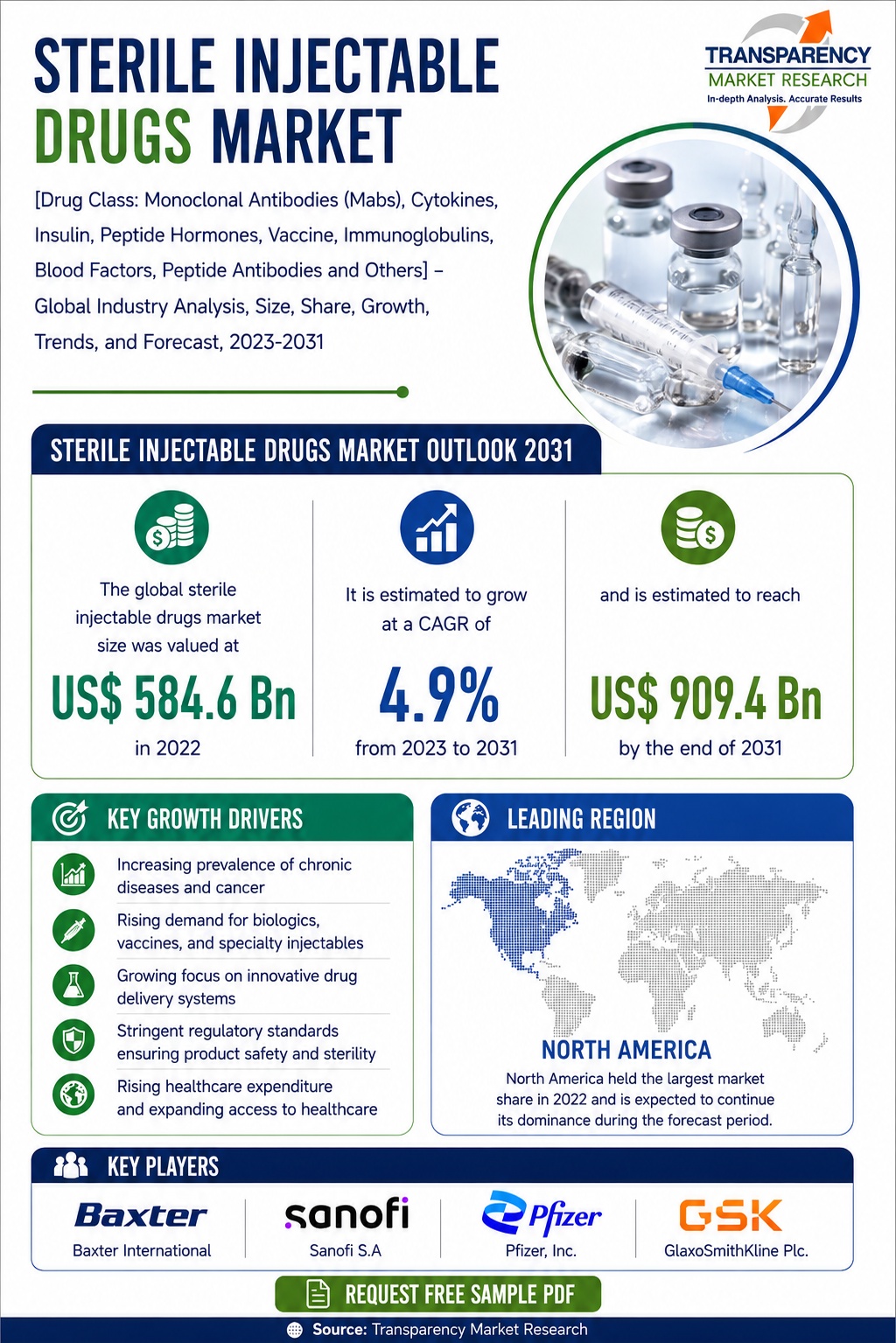
The global Pharmaceutical Industry is witnessing substantial growth as healthcare systems worldwide increasingly rely on injectable therapies for the treatment of chronic and acute diseases. According to industry analysis, the global sterile injectable drugs market was valued at US$ 584.6 Bn in 2022 and is projected to reach US$ 909.4 Bn by the end of 2031, expanding at a CAGR of 4.9% during the forecast period from 2023 to 2031.
Sterile injectable drugs are medications administered directly into the bloodstream or body tissues under highly controlled sterile conditions. These products include vaccines, monoclonal antibodies, insulin formulations, peptide hormones, blood factors, and oncology injectables. Since these drugs bypass the body’s natural defense mechanisms, maintaining sterility throughout manufacturing and administration is critical.
The market is benefiting from the growing prevalence of chronic diseases such as cancer, diabetes, cardiovascular disorders, autoimmune conditions, and infectious diseases. Additionally, rising healthcare expenditure, increasing adoption of generic injectable drugs, and continuous innovation in drug delivery technologies are contributing significantly to market expansion.
Injectable therapies are widely preferred in hospitals and specialty clinics because they provide rapid absorption, enhanced bioavailability, and faster therapeutic action compared to oral medications. Furthermore, the increasing aging population globally is creating sustained demand for injectable therapies used in long-term disease management.
Download now to explore primary insights from our Report in this sample – https://www.transparencymarketresearch.com/sample/sample.php?flag=S&rep_id=34427
Key Drivers of Market Growth
Rising Demand for Generic Injectable Drugs
One of the major factors driving the sterile injectable drugs market is the growing preference for generic medications. Healthcare providers and patients are actively seeking affordable alternatives to expensive branded drugs. Generic sterile injectables offer comparable efficacy and safety while significantly reducing treatment costs.
Governments and healthcare organizations across developed and emerging economies are also promoting generic drug adoption to reduce healthcare spending. This trend is expected to create lucrative opportunities for pharmaceutical manufacturers specializing in sterile injectable formulations.
Increasing Prevalence of Chronic Diseases
The growing burden of chronic diseases is another key growth catalyst for the market. Conditions such as diabetes, cancer, neurological disorders, and cardiovascular diseases require long-term treatment regimens, many of which involve injectable therapies.
Cancer incidence, in particular, continues to rise globally, increasing demand for oncology injectables, monoclonal antibodies, and targeted biologic therapies. Injectable treatments are also essential in emergency care, intensive care units, and critical disease management.
According to healthcare estimates, the diabetic population worldwide is expanding rapidly, further increasing the need for insulin injections and other injectable therapies designed for metabolic disorders.
Advancements in Drug Delivery Technologies
Technological innovations in injectable drug delivery systems are improving treatment outcomes and patient convenience. Companies are increasingly investing in prefilled syringes, auto-injectors, wearable injectors, and advanced biologic formulations.
These advancements help reduce medication errors, improve dosing accuracy, and enhance patient compliance. The adoption of innovative manufacturing technologies is also enabling pharmaceutical companies to improve production efficiency while maintaining strict sterility standards.
Growth in Healthcare Investments
Increasing public and private investments in healthcare infrastructure and pharmaceutical research are supporting market expansion. Governments are allocating larger budgets for healthcare modernization, while pharmaceutical companies are significantly increasing spending on research and development activities.
Several manufacturers are also expanding sterile manufacturing facilities to meet rising global demand for injectable medications. Strategic mergers, acquisitions, and partnerships are helping companies strengthen production capabilities and expand their market presence.
Key Players and Industry Leaders
The global sterile injectable drugs market is highly competitive and includes several multinational pharmaceutical giants and specialized injectable manufacturers. Major players are focusing on expanding product portfolios, enhancing manufacturing capabilities, and developing innovative biologic therapies.
Leading companies operating in the market include:
- Baxter International
- Sanofi S.A
- Pfizer, Inc.
- GlaxoSmithKline Plc.
- AstraZeneca
- Merck & Co., Inc.
- Novartis AG
- Johnson & Johnson Services, Inc.
- Novo Nordisk A/S
- Gilead Sciences, Inc.
These companies are actively investing in research initiatives focused on biologics, oncology injectables, immunotherapies, and advanced sterile formulations. Many industry leaders are also leveraging automation and digital technologies to optimize manufacturing processes and ensure regulatory compliance.
Recent Developments
The sterile injectable drugs industry has witnessed several noteworthy developments aimed at expanding therapeutic capabilities and improving patient outcomes.
In November 2022, AstraZeneca received approval from the U.S. Food and Drug Administration for tremelimumab (Imjudo) in combination with durvalumab (Imfinzi) and platinum-based chemotherapy for treating metastatic non-small cell lung cancer patients without specific genetic mutations.
In May 2022, Eli Lilly and Company received FDA approval for Mounjaro (tirzepatide), a once-weekly injectable therapy indicated for improving glycemic control in adults with type 2 diabetes.
Additionally, in February 2022, Takeda Pharmaceutical Company secured FDA authorization for the TAKHZYRO injectable prefilled syringe to prevent hereditary angioedema attacks in pediatric and adult patients.
Pharmaceutical manufacturers are also increasing investments in production expansion projects. Several companies are constructing new sterile manufacturing plants to strengthen supply chains and address growing global demand.
Key Trends for the Future
Several important trends are expected to shape the future of the sterile injectable drugs market:
- Increasing adoption of biologic and biosimilar therapies
- Rising investments in sterile manufacturing facilities
- Expansion of self-administered injectable devices
- Greater focus on oncology and immunotherapy injectables
- Integration of automation and AI-driven manufacturing technologies
- Growth in emerging pharmaceutical markets
- Increasing demand for cost-effective generic injectables
- Expansion of personalized medicine approaches
As healthcare systems worldwide continue prioritizing efficient and targeted treatment solutions, sterile injectable drugs are expected to remain central to modern therapeutics.
New Opportunities and Challenges
Emerging Opportunities
The market presents significant growth opportunities in biologics and biosimilars. The increasing adoption of monoclonal antibodies, peptide-based therapies, and immunotherapies is expected to create strong revenue potential for manufacturers.
Emerging economies in Asia Pacific, Latin America, and the Middle East are also offering new growth avenues due to improving healthcare infrastructure and increasing healthcare access.
The growing demand for home-based healthcare and self-administered injectables is encouraging pharmaceutical companies to develop user-friendly delivery systems such as wearable injectors and prefilled devices.
Industry Challenges
Despite promising growth prospects, the market faces several operational and regulatory challenges. Sterile injectable manufacturing requires highly sophisticated infrastructure, advanced contamination control systems, and strict adherence to regulatory guidelines.
Product recalls due to contamination risks can significantly impact manufacturers financially and reputationally. Additionally, the high cost associated with sterile manufacturing facilities and quality assurance processes remains a barrier for smaller companies.
Supply chain disruptions, shortages of raw materials, and increasing regulatory scrutiny are also affecting production timelines and operational efficiency.
Market Trends & Innovations
Expansion of Biologic Injectable Therapies
Biologics continue to dominate innovation within the sterile injectable drugs industry. Monoclonal antibodies and targeted therapies are gaining widespread acceptance in oncology, autoimmune disorders, and rare disease treatment.
The monoclonal antibodies segment accounted for a major market share in 2022 and is expected to maintain strong growth momentum during the forecast period.
Adoption of Prefilled Syringes and Auto-Injectors
The industry is witnessing rising demand for prefilled syringes and auto-injector devices due to their convenience and improved safety. These systems reduce contamination risk and enable accurate dosing, making them increasingly popular among healthcare professionals and patients.
Focus on Biosimilars
As several biologic drug patents expire, pharmaceutical companies are aggressively investing in biosimilar development. Biosimilars offer cost-effective alternatives to branded biologics and are expected to reshape competitive dynamics in the injectable drugs market.
Digitalization of Manufacturing
Automation and digital manufacturing technologies are transforming sterile injectable production facilities. Companies are adopting robotics, artificial intelligence, and advanced monitoring systems to improve sterility assurance, reduce production errors, and increase manufacturing scalability.
Buy this Premium Research Report for a deep dive into essential data – https://www.transparencymarketresearch.com/checkout.php?rep_id=34427<ype=S
Future Outlook
The future outlook for the global sterile injectable drugs market remains highly positive. Rising disease prevalence, growing biologics adoption, and increasing demand for affordable therapies are expected to sustain long-term market growth.
North America is anticipated to maintain its dominant position due to advanced healthcare infrastructure, significant R&D investments, and strong presence of major pharmaceutical companies. Europe is also expected to witness stable growth owing to favorable healthcare policies and increasing biologics adoption.
Meanwhile, Asia Pacific is projected to emerge as the fastest-growing regional market due to rising healthcare expenditure, expanding pharmaceutical manufacturing capabilities, and growing patient populations in countries such as China and India.
The growing emphasis on personalized medicine, targeted biologic therapies, and innovative drug delivery systems is likely to redefine the competitive landscape over the next decade.
Market Segmentation
By Type
- Small Molecule
- Large Molecule
By Drug Class
- Monoclonal Antibodies (MAbs)
- Cytokines
- Insulin
- Peptide Hormones
- Vaccines
- Immunoglobulins
- Blood Factors
- Peptide Antibiotics
- Others
By Indication
- Cardiology & Metabolic Disorders
- Neurology
- Oncology
- Autoimmune Diseases
- Gastroenterology
- Hematology
- Pain Management
- Infectious Diseases
- Others
By Distribution Channel
- Hospital Pharmacy
- Retail Pharmacy
- E-commerce
By Region
- North America
- Europe
- Asia Pacific
- Latin America
- Middle East & Africa
Important FAQs with Answers
How large was the sterile injectable drugs market in 2022?
The global sterile injectable drugs market was valued at US$ 584.6 Bn in 2022.
What is the expected market value by 2031?
The market is projected to reach US$ 909.4 Bn by the end of 2031.
What is the projected CAGR during the forecast period?
The market is expected to grow at a CAGR of 4.9% from 2023 to 2031.
What are the key growth drivers of the market?
Major growth drivers include increasing demand for generic injectable drugs, rising prevalence of chronic diseases, technological advancements in drug delivery systems, and growing healthcare investments.
Which segment dominated the market in 2022?
The monoclonal antibodies (MAbs) segment held the largest market share in 2022.
Which region accounted for the largest market share?
North America dominated the global sterile injectable drugs market in 2022.
What challenges does the industry face?
The industry faces challenges such as stringent regulatory requirements, contamination risks, high manufacturing costs, and supply chain disruptions.
Who are the leading companies in the sterile injectable drugs market?
Key players include Pfizer, Inc., Sanofi S.A, AstraZeneca, Novartis AG, and Baxter International.
More Related Reports –
Bioengineered Protein Drugs Market: https://www.transparencymarketresearch.com/bioengineered-proteins-drugs-market.html
Gene Delivery System Market: https://www.transparencymarketresearch.com/gene-delivery-system-market.html
Drug and Gene Delivery Systems Market: https://www.transparencymarketresearch.com/drug-gene-delivery-system-market.html
Liposome Drug Delivery Market: https://www.transparencymarketresearch.com/liposome-drug-delivery-market.html
About Us Transparency Market Research
Transparency Market Research, a global market research company registered at Wilmington, Delaware, United States, provides custom research and consulting services. The firm scrutinizes factors shaping the dynamics of demand in various markets. The insights and perspectives on the markets evaluate opportunities in various segments. The opportunities in the segments based on source, application, demographics, sales channel, and end-use are analysed, which will determine growth in the markets over the next decade.
Our exclusive blend of quantitative forecasting and trends analysis provides forward-looking insights for thousands of decision-makers, made possible by experienced teams of Analysts, Researchers, and Consultants. The proprietary data sources and various tools & techniques we use always reflect the latest trends and information. With a broad research and analysis capability, Transparency Market Research employs rigorous primary and secondary research techniques in all of its business reports.
Contact:
Abhishek Budholiya
Transparency Market Research Inc.
State Tower, 90 State Street, Suite 700,
Albany NY – 12207, United States
Tel: +1-518-618-1030
USA – Canada Toll Free: 866-552-3453
Website: https://www.transparencymarketresearch.com
Media Inquiries: media@transparencymarketresearch.com
Sales Inquiries: sales@transparencymarketresearch.com



Leave a Reply