The global veterinary vaccines market was valued at approximately US$ 6,100 million in 2017 and is projected to reach US$ 12,000 million by 2026, expanding at a compound annual growth rate (CAGR) of over 6.5% during the forecast period from 2018 to 2026. The market’s robust growth reflects the increasing importance of animal health in global food security, public health, and economic sustainability.
The rising incidence of infectious diseases in livestock and companion animals, along with growing awareness of zoonotic diseases, is driving the steady expansion of the veterinary vaccines market worldwide.
Gain a preview of important insights from our Report in this sample –
https://www.transparencymarketresearch.com/sample/sample.php?flag=S&rep_id=215
Market Overview
Veterinary vaccines play a critical role in preventing and controlling diseases among animals, particularly livestock and companion animals. These vaccines are essential components of integrated disease management strategies aimed at improving animal health, ensuring food safety, and preventing the transmission of diseases from animals to humans.
The development of veterinary vaccines has evolved significantly, supported by advancements in biotechnology, immunology, and disease surveillance. Modern vaccine development focuses on achieving optimal balance among cost, safety, and efficacy, which are key determinants influencing product adoption and market growth.
Veterinary vaccines are widely used across various animal categories, including cattle, poultry, swine, and pets. Their applications range from preventing infectious diseases to addressing non-infectious conditions such as allergies and certain cancers.
The increasing emphasis on animal welfare, coupled with stringent regulatory frameworks and global disease eradication initiatives, has strengthened the demand for veterinary vaccines across regions.
Key Market Growth Drivers
A primary driver of the veterinary vaccines market is the economic burden of infectious diseases in livestock. Diseases affecting livestock can lead to significant financial losses due to reduced productivity, mortality, and trade restrictions. Vaccination serves as a cost-effective preventive measure, helping farmers and governments mitigate these risks.
Another major growth driver is the rising concern over zoonotic diseases, which can be transmitted from animals to humans. The need to safeguard human health has intensified efforts to develop and deploy vaccines for diseases such as rabies and avian influenza.
The growing demand for animal protein is also contributing to market growth. As global populations rise, the demand for meat, dairy, and poultry products increases, necessitating improved animal health management practices, including vaccination.
Additionally, the increasing adoption of companion animals has boosted demand for veterinary vaccines in the pet care segment. Pet owners are becoming more aware of preventive healthcare, driving vaccination rates for domestic animals.
Advancements in vaccine technologies, including DNA vaccines and live attenuated vaccines, are further accelerating market growth by offering improved efficacy and broader protection.
Analysis of Key Players – Key Player Strategies
The veterinary vaccines market is characterized by strong competition among global and regional players focusing on innovation, research, and strategic expansion. Companies are investing significantly in research and development (R&D) to develop advanced vaccines that offer improved safety profiles and higher efficacy.
A key strategy adopted by market players is technology diversification, with a focus on developing multiple vaccine types such as inactivated, conjugate, live attenuated, and toxoid vaccines. This enables companies to cater to a wide range of diseases and animal species.
Strategic collaborations and partnerships with research institutions and government bodies are also common. These collaborations facilitate knowledge sharing, accelerate product development, and support large-scale vaccination programs.
Another important strategy is geographical expansion, particularly in emerging markets where demand for veterinary vaccines is rising due to increasing livestock production and improving healthcare infrastructure.
Companies are also focusing on cost optimization and scalability to make vaccines more accessible, especially in developing regions where affordability is a key concern.
Market Challenges & Opportunities
Despite strong growth prospects, the veterinary vaccines market faces several challenges. One of the key challenges is the high cost of vaccine development and regulatory approval, which can limit the entry of new players and slow innovation.
Another challenge is the limited adoption of advanced vaccines in certain regions, particularly in developing countries where awareness and infrastructure may be lacking.
The complexity of disease patterns and pathogen variability also poses challenges for vaccine development, requiring continuous research and adaptation.
However, the market offers significant opportunities. The emergence of DNA vaccines represents a major growth avenue, offering advantages such as ease of design, cost-effectiveness, and the ability to induce both cellular and humoral immune responses.
The growing focus on disease prevention rather than treatment is creating opportunities for increased vaccine adoption. Governments and organizations are investing in vaccination programs to reduce disease outbreaks and improve animal health.
Additionally, advancements in delivery methods and administration routes, including oral vaccines, are enhancing convenience and expanding market reach.
Key Player Strategies
Key players in the veterinary vaccines market are employing several strategic initiatives to maintain competitiveness:
- R&D Investments: Developing innovative vaccines with improved efficacy and safety
- Product Portfolio Expansion: Offering a wide range of vaccines targeting different diseases and animal types
- Collaborations: Partnering with governments and research organizations
- Emerging Market Focus: Expanding presence in Asia Pacific, Latin America, and Africa
- Technological Innovation: Leveraging advancements in DNA vaccines and delivery systems
These strategies are enabling companies to address evolving market demands and strengthen their global footprint.
Recent Developments
The report highlights ongoing advancements in vaccine technologies, particularly in DNA vaccines and live attenuated vaccines, which are attracting significant R&D investments.
Continuous improvements in antigen optimization, delivery methods, and expression vectors are enhancing the effectiveness of next-generation veterinary vaccines.
Regulatory approvals for specific applications, such as vaccines targeting avian influenza and other high-impact diseases, are further supporting market growth.
Investment Landscape and ROI Outlook
The veterinary vaccines market presents a strong investment opportunity, driven by its critical role in global food security and public health. The increasing demand for animal protein and rising awareness of zoonotic diseases are creating a favorable environment for investment.
The return on investment (ROI) outlook is positive, particularly for companies focusing on innovative technologies such as DNA vaccines and advanced delivery systems. Investments in R&D and manufacturing capabilities are expected to yield long-term benefits.
Emerging markets offer significant growth potential due to increasing livestock production and improving veterinary healthcare infrastructure. Government support and funding for vaccination programs further enhance investment prospects.
Market Segmentations
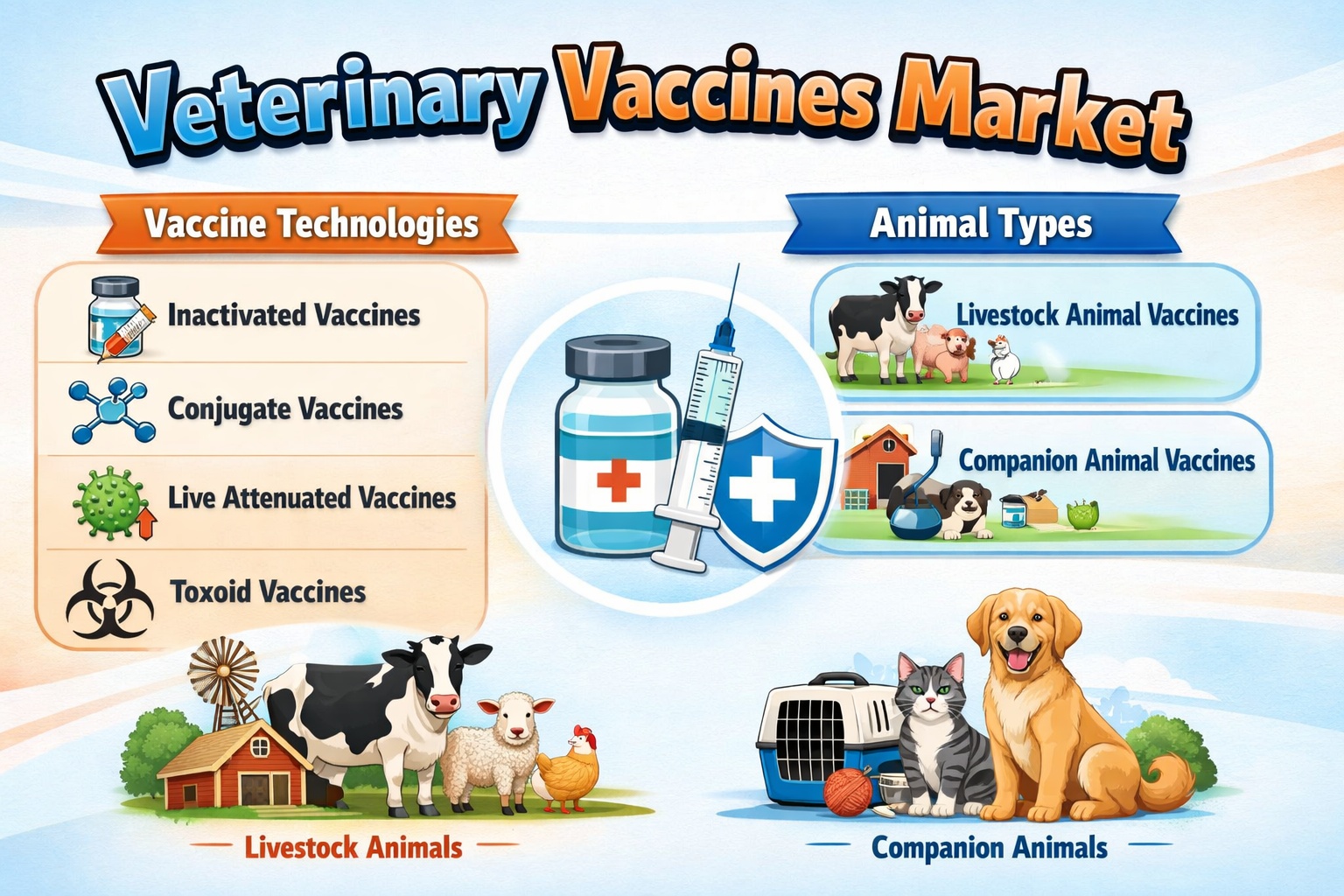
The veterinary vaccines market is segmented based on technology, animal type, and region.
By technology, the market includes inactivated vaccines, conjugate vaccines, live attenuated vaccines, and toxoid vaccines. Among these, live attenuated vaccines hold a significant share due to their high efficacy and broad antigen expression.
By animal type, the market is divided into livestock animal vaccines and companion animal vaccines. Livestock vaccines dominate the market due to their critical role in food production and economic stability.
Regionally, the market is segmented into North America, Europe, Asia Pacific, Latin America, and the Middle East & Africa. North America leads the market, supported by robust vaccination programs, high pet ownership, and advanced veterinary healthcare infrastructure.
Asia Pacific is emerging as a high-growth region, driven by increasing livestock production, rising awareness, and government initiatives to control animal diseases.
Why Buy This Report?
- Comprehensive analysis of market size, growth trends, and forecasts
- Detailed insights into key drivers, challenges, and opportunities
- In-depth evaluation of technology advancements and innovations
- Competitive landscape and strategic analysis of key players
- Identification of high-growth regions and investment opportunities
- Actionable insights for business expansion and decision-making
FAQs
1. What is driving the growth of the veterinary vaccines market?
The market is driven by the economic burden of livestock diseases, rising zoonotic disease concerns, and increasing demand for animal protein.
2. Which technology segment is leading the market?
Live attenuated vaccines hold a significant share due to their high efficacy and ability to provide broad protection.
3. Which region dominates the market?
North America leads the market due to strong vaccination programs and advanced healthcare infrastructure.
4. What are the key challenges in the market?
Major challenges include high development costs, regulatory complexities, and limited adoption in certain regions.
5. What is the future outlook for the market?
The market is expected to grow steadily, driven by technological advancements, increasing awareness, and expanding vaccination programs.


Leave a Reply