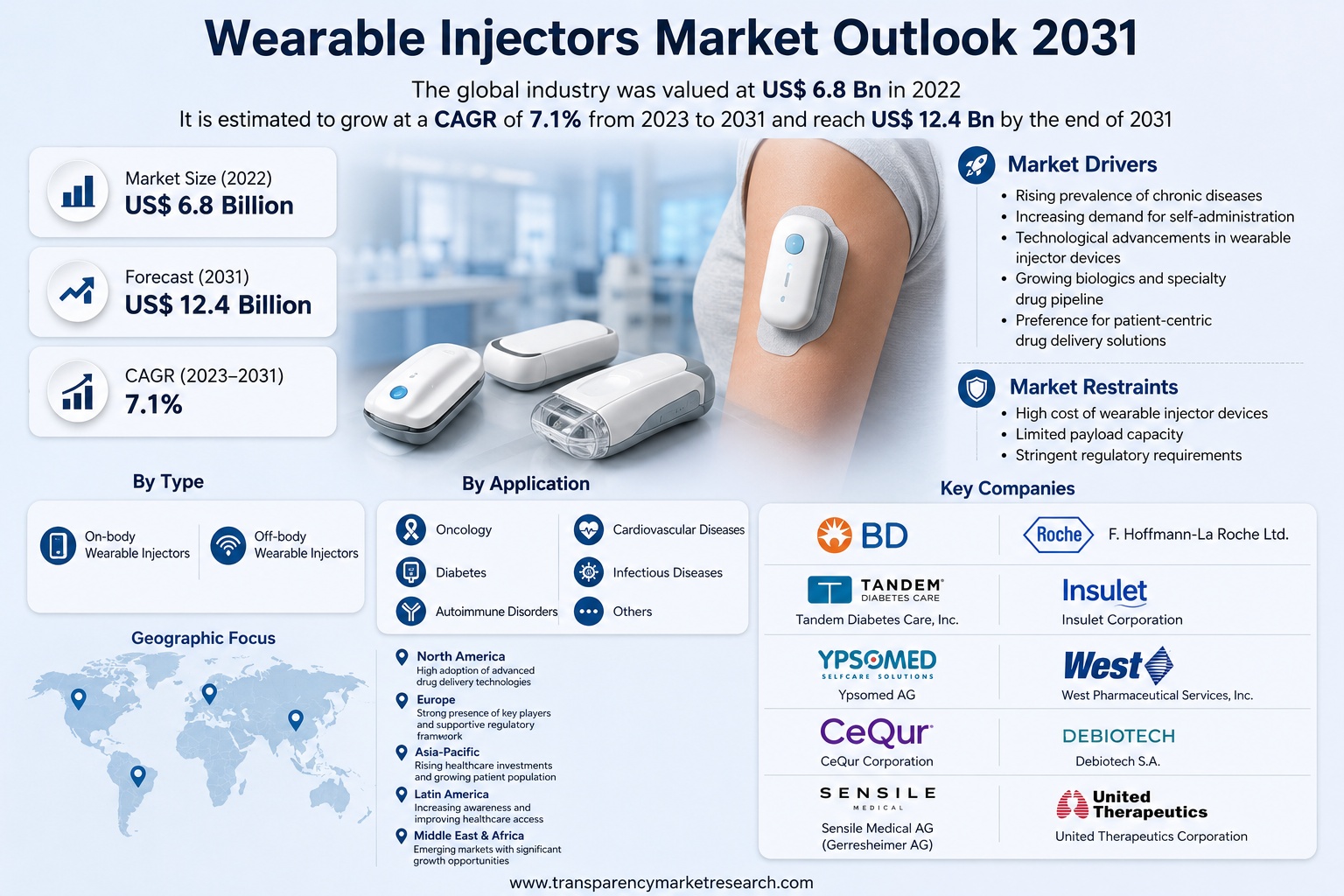
The global wearable injectors market is witnessing robust growth as healthcare providers and patients increasingly adopt advanced drug delivery systems for chronic disease management. Wearable injectors are innovative medical devices designed to automatically administer prescribed doses of medication over a specific period while attached to the patient’s body. These devices have become an essential component of modern healthcare by enabling convenient, accurate, and self-administered treatment outside traditional clinical settings.
👉 Get sample market research report copy now@ https://www.transparencymarketresearch.com/sample/sample.php?flag=S&rep_id=41969
The global wearable injectors industry was valued at US$ 6.8 Bn in 2022 and is projected to reach US$ 12.4 Bn by the end of 2031, expanding at a CAGR of 7.1% during the forecast period from 2023 to 2031. Growing demand for home-based healthcare, increasing prevalence of chronic diseases, and continuous technological innovations are expected to support long-term market expansion.
Market Overview
Wearable injectors are primarily used to deliver large-volume biologics and specialty drugs through subcutaneous administration. These devices provide patients with a comfortable and efficient alternative to conventional intravenous infusions and frequent hospital visits. They are widely adopted for treating chronic conditions such as diabetes, oncology, autoimmune disorders, cardiovascular diseases, and infectious diseases.
The healthcare industry is increasingly focusing on patient-centric drug delivery solutions that improve treatment adherence and reduce healthcare costs. As pharmaceutical companies continue to develop biologics requiring precise and controlled administration, wearable injectors are becoming an integral part of next-generation drug delivery systems. Their ability to improve convenience, reduce injection frequency, and support remote patient monitoring is significantly boosting market demand worldwide.
Key Drivers of Market Growth
One of the primary factors driving the wearable injectors market is the growing preference for home healthcare. Patients increasingly prefer receiving treatment at home rather than visiting hospitals or infusion centers, creating strong demand for wearable drug delivery systems that simplify medication administration.
The rapid shift from intravenous therapies to subcutaneous drug delivery is also supporting market growth. Pharmaceutical companies are reformulating biologic therapies for subcutaneous administration, enabling patients to self-administer medications safely using wearable injectors.
Technological advancements in wearable injector design and manufacturing continue to accelerate market development. Manufacturers are introducing devices with smart connectivity, mobile application integration, improved wearability, reduced injection time, and enhanced patient comfort. These innovations improve treatment adherence while reducing pain and minimizing administration errors.
The expansion of the global biopharmaceutical industry is another important growth driver. The increasing number of biologic drugs developed for chronic diseases requires specialized delivery systems capable of handling high-volume and high-viscosity formulations. Wearable injectors provide an ideal solution for these advanced therapies.
Additionally, rising incidences of diabetes, cancer, autoimmune disorders, and other chronic illnesses continue to increase demand for reliable self-injection technologies across global healthcare systems.
Key Players and Industry Leaders
The wearable injectors market is highly competitive, with several global medical technology companies investing heavily in product innovation and strategic partnerships. Leading manufacturers focus on expanding their product portfolios, improving patient usability, and obtaining regulatory approvals for advanced wearable injection systems.
Major companies operating in the global wearable injectors market include BD, F. Hoffmann-La Roche Ltd., Tandem Diabetes Care, Inc., Insulet Corporation, Ypsomed AG, West Pharmaceutical Services, Inc., CeQur Corporation, Debiotech S.A., Sensile Medical AG (Gerresheimer AG), and United Therapeutics Corporation.
Recent industry developments further demonstrate the market’s dynamic nature. In October 2023, Enable Injections received U.S. FDA approval for its enFuse injector used to deliver Empaveli. In June 2023, LTS acquired Eitan Medical’s Sorrel business to strengthen its wearable injector technology capabilities. BD also reinforced its presence in the pharmaceutical drug delivery industry through its participation in Pharmapack 2023.
Key Trends for the Future
Several emerging trends are expected to shape the future of the wearable injectors market throughout the forecast period.
The increasing adoption of smart wearable injectors equipped with wireless connectivity and digital health monitoring features is enhancing patient engagement and treatment compliance. Integration with smartphones and healthcare applications allows patients and physicians to monitor therapy progress in real time.
Another significant trend is the growing use of wearable injectors for high-volume biologic therapies, particularly in oncology, immunology, and rare disease treatments. The industry is also witnessing increasing demand for patient-friendly devices that reduce setup time, improve mobility during infusion, and provide greater comfort.
Manufacturers are focusing on developing compact, lightweight, and user-friendly devices that support personalized healthcare and remote patient management.
Explore our report to uncover in-depth insights – https://www.transparencymarketresearch.com/wearable-injectors-market.html
New Opportunities and Challenges
The expanding home healthcare sector presents substantial growth opportunities for wearable injector manufacturers. Increasing healthcare expenditure, aging populations, and greater awareness regarding self-care are encouraging broader adoption of wearable drug delivery systems across developed and emerging markets.
Asia Pacific represents a particularly promising opportunity due to its growing patient population, rising chronic disease prevalence, improving healthcare infrastructure, and expanding pharmaceutical manufacturing sector.
Despite these opportunities, several challenges remain. High development costs, stringent regulatory approval requirements, complex manufacturing processes, and device reimbursement limitations may hinder market growth. Additionally, ensuring product reliability, patient safety, and cybersecurity for connected devices remains an important industry priority.
Market Trends & Innovations
Continuous innovation remains a defining characteristic of the wearable injectors industry. Manufacturers are introducing advanced on-body delivery systems capable of delivering larger drug volumes with greater precision and minimal patient intervention.
Prefilled wearable injectors designed for vaccines and biologic therapies are becoming increasingly common. New-generation devices also incorporate digital connectivity features that allow healthcare providers to track adherence and optimize treatment outcomes.
The industry is experiencing increased adoption of wearable injectors across multiple therapeutic areas beyond diabetes, including oncology, neurology, autoimmune disorders, cardiovascular diseases, and infectious diseases. Improvements in ergonomic design, adhesive technology, battery performance, and infusion control continue to enhance patient experience and expand clinical applications.
Future Outlook
The future outlook for the wearable injectors market remains highly positive. Rising demand for convenient drug delivery systems, expanding biologics pipelines, and increasing preference for home-based treatment are expected to sustain market growth through 2031.
North America is anticipated to maintain its leading market position due to advanced healthcare infrastructure, growing home healthcare expenditure, and continuous technological innovation. Meanwhile, Asia Pacific is expected to witness the fastest growth, supported by increasing healthcare investments, rising awareness, and expanding access to advanced medical technologies.
As healthcare systems continue emphasizing patient-centered care and cost-effective treatment solutions, wearable injectors will play an increasingly important role in chronic disease management and specialty drug administration.
Market Segmentation
By Type
- On-body Wearable Injectors
- Off-body Wearable Injectors
By Application
- Oncology
- Diabetes
- Autoimmune Disorders
- Cardiovascular Diseases
- Infectious Diseases
- Others
By End-user
- Hospitals
- Clinics
- Home Care Settings
- Others
By Region
- North America
- Europe
- Asia Pacific
- Latin America
- Middle East & Africa
👉 To buy this comprehensive market research report, click here to inquire@ https://www.transparencymarketresearch.com/checkout.php?rep_id=41969<ype=S
Important FAQs with Answers
- What was the value of the wearable injectors market in 2022?
The market was valued at US$ 6.8 Bn in 2022. - What is the projected market value by 2031?
The global wearable injectors market is expected to reach US$ 12.4 Bn by 2031. - What is the expected CAGR during the forecast period?
The market is projected to grow at a 7.1% CAGR between 2023 and 2031. - What factors are driving market growth?
Key growth drivers include rising demand for home healthcare, technological advancements, increasing chronic disease prevalence, and growing adoption of biologic therapies. - Which region dominated the market in 2022?
North America held the largest share due to advanced healthcare infrastructure and increasing adoption of patient-centric drug delivery solutions.
More Trending Reports by Transparency Market Research –
Bone Marrow Aspirate Concentrates Market: https://www.transparencymarketresearch.com/bone-marrow-aspirate-concentrates-market.html
Microplate Reader Market: https://www.transparencymarketresearch.com/microplate-readers-market.html
Next Generation Sequencers (NGS) Market: https://www.transparencymarketresearch.com/next-generation-sequencers-market.html
About Transparency Market Research
Transparency Market Research, a global market research company registered at Wilmington, Delaware, United States, provides custom research and consulting services. Our exclusive blend of quantitative forecasting and trends analysis provides forward-looking insights for thousands of decision makers. Our experienced team of Analysts, Researchers, and Consultants use proprietary data sources and various tools & techniques to gather and analyses information.
Our data repository is continuously updated and revised by a team of research experts, so that it always reflects the latest trends and information. With a broad research and analysis capability, Transparency Market Research employs rigorous primary and secondary research techniques in developing distinctive data sets and research material for business reports.
Media Contact:
Abhishek Budholiya
Transparency Market Research Inc.
State Tower, 90 State Street, Suite 700,
Albany NY – 12207, United States
Tel: +1-518-618-1030
USA – Canada Toll Free: 866-552-3453
Website: https://www.transparencymarketresearch.com
Sales Inquiries: sales@transparencymarketresearch.com
Media Inquiries: media@transparencymarketresearch.com



Leave a Reply